Author: getcustomlighters.com

  • Metal Flip-Top vs Plastic Custom Lighters: What the Premium Actually Buys

    Metal Flip-Top vs Plastic Custom Lighters: What the Premium Actually Buys

    Put a branded plastic lighter and a branded metal flip-top on the same counter and the price tags tell two completely different stories. A custom plastic disposable can land under a dollar a piece, while a custom metal windproof lighter in the Zippo mold runs north of twenty dollars each. That is not a small upgrade; it is a roughly twenty-fold jump, and it changes what the item is for. Understanding what that premium actually buys, and when it is worth paying, is the difference between a smart gift and a wasted budget.

    What drives the price gap

    The gap is not markup for its own sake. A plastic disposable is exactly that: a sealed body, a fixed charge of fuel, and a striker, built to be made by the million and thrown away when empty. A metal flip-top is a machined, refillable mechanism, a hinged lid, a replaceable flint, a wick, and a wind-resistant chimney, wrapped in a solid metal case designed to be carried for years and handed down. You are paying for durability, refillability, wind resistance, and a heft that reads as a real object rather than a giveaway. The decoration differs too. Metal cases are typically laser-engraved, cutting your mark permanently into the surface, while plastic bodies are wrapped or printed, which looks great but lives on the outside of the item rather than in it.

    The order math points the same direction. Plastic lighters are cheap per piece but usually carry minimums in the range of a few hundred units, so the entry cost is a large run of an inexpensive item. Metal windproof lighters flip that: minimums are often just thirty to fifty pieces, but each one costs many times more. The result is two different ways to spend a similar amount of money, one on a crowd and one on a chosen few.
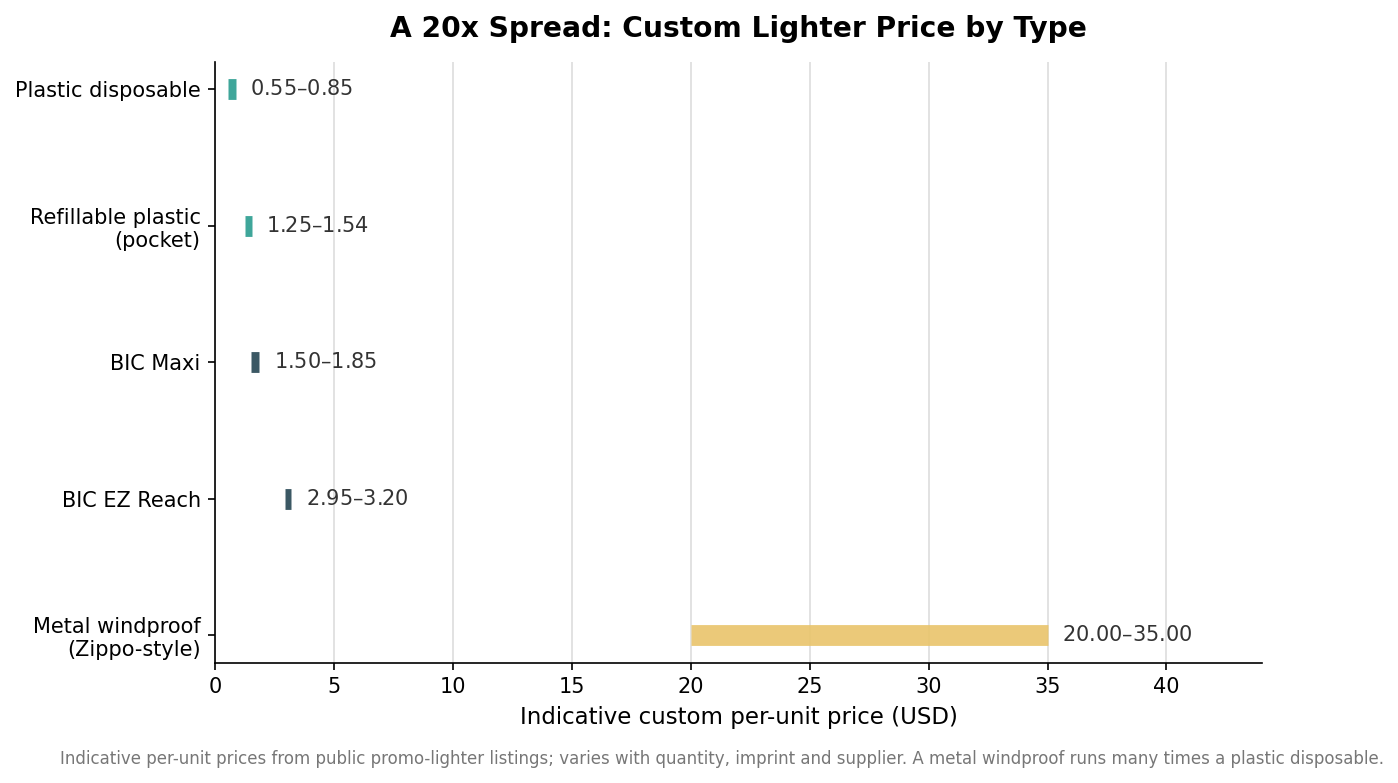
    Horizontal range chart of indicative custom per-unit price for plastic disposable, refillable plastic, BIC Maxi, BIC EZ Reach and metal windproof lighters
    Indicative custom per-unit prices; a metal windproof runs roughly twenty times a plastic disposable.

    When the metal premium pays off

    Metal flip-tops earn their price when the lighter is meant to be kept. If the goal is a keepsake or a gift with weight, the economics invert: a twenty-five dollar engraved lighter that someone carries daily for five years and refills without a thought delivers your brand or message every single time it is used, which no disposable can match. That makes them a natural fit for executive and VIP gifts, milestone and anniversary pieces, groomsmen gifts, high-end cigar lounges and members’ clubs, and any moment where the object is supposed to signal that thought and money went into it. The permanence of engraving reinforces the point, since the mark will outlast the fuel, the flint, and probably several wicks.

    The low minimum is part of the appeal here. Because you can order a metal run in the low dozens, they suit small, deliberate batches, a set for a leadership team, a wedding party, or a limited anniversary drop, rather than a warehouse of stock. When the plan is to give a specific person something they will actually pocket and reuse, the metal premium is the whole point, not an overspend.

    When plastic is the smarter spend

    For volume, plastic wins on the only metric that matters at scale: cost per impression. If you are seeding a festival crowd, stocking a bar’s register, filling event bags, or handing out swag where you will never see most recipients again, spending twenty-plus dollars a unit is indefensible. A sub-dollar to roughly two-dollar plastic lighter, printed with a bold, legible mark, puts your brand in a thousand pockets for the price of a few dozen metal ones. Losses do not sting, because the item was always semi-disposable, and a strong wrap-printed graphic reads clearly across a room.

    There is a middle tier worth knowing. Refillable plastic pocket lighters and premium disposables such as the BIC Maxi or the longer BIC EZ Reach sit between the throwaway and the metal keepsake, typically from just over a dollar to around three dollars a piece. They give a bit more perceived value and, in the refillable case, a longer life, without leaving the affordable, high-volume lane. For a lot of bar, brewery, and event programs, that middle tier is the sweet spot: nicer than a bottom-shelf disposable, still cheap enough to give away freely.
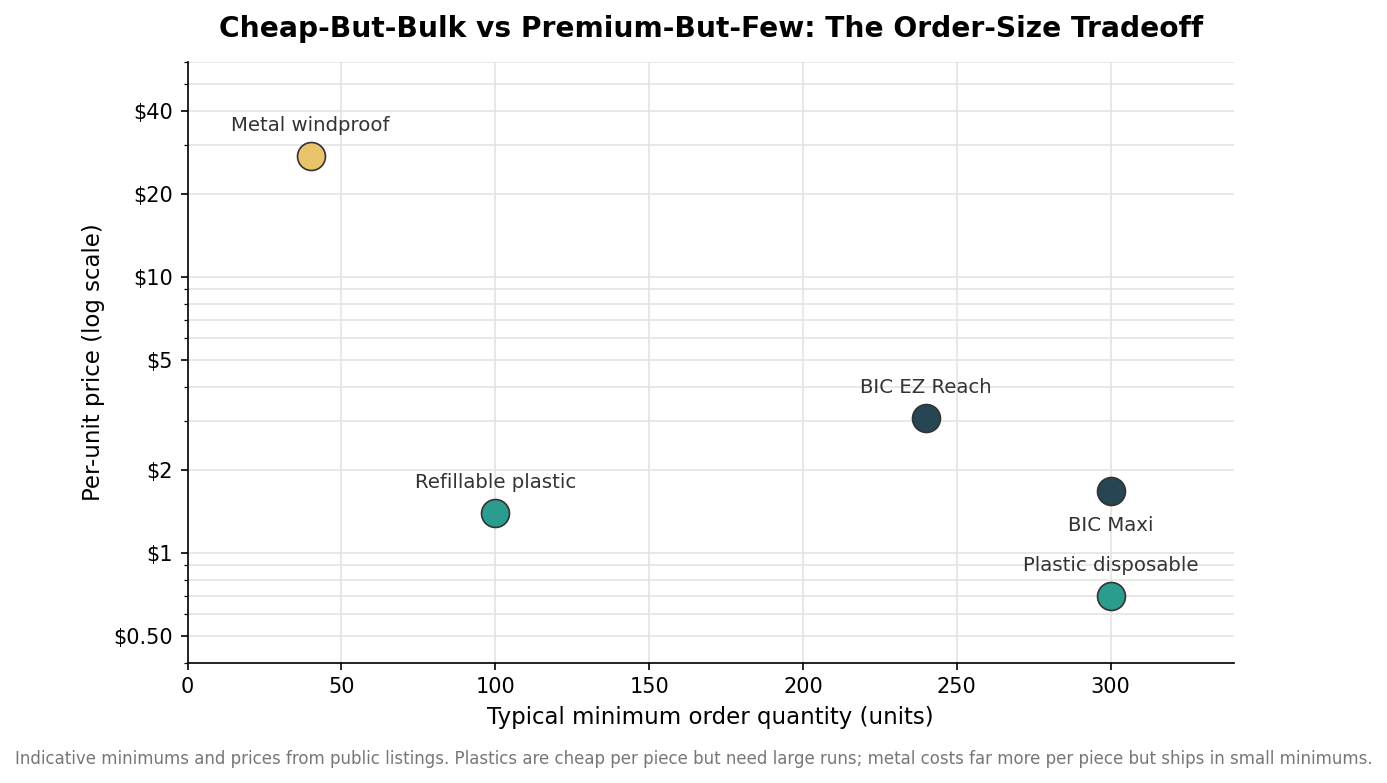
    Scatter plot of typical minimum order quantity versus per-unit price on a log scale for five custom lighter types
    The order-size tradeoff: cheap plastics need large runs, metal costs more per piece but ships in small minimums.

    How to choose, and how to order

    Start from the item’s job, not its price. If the lighter is a mass touchpoint meant to spread a logo as widely and cheaply as possible, buy plastic, invest in a clean high-contrast print, and order the volume the cost-per-impression math rewards. If the lighter is a gift meant to be carried and remembered, buy metal, engrave it, and order the small, deliberate batch the occasion calls for. Many brands do both in the same year: a large plastic run for the crowd and a small engraved metal run for the people who matter most, each doing a job the other cannot.

    A few practical notes before you place an order. Match the decoration to the body, since engraving suits metal and wrap or pad printing suits plastic, and ask to see the imprint area for the specific model so your artwork fits cleanly. Confirm the real per-unit price at your quantity, because both tiers move with volume and imprint complexity, and check the minimum before you fall in love with a body you cannot order in the quantity you need. Finally, remember that lighters are a regulated flammable good, which affects how they ship and how quickly, so build a little lead time in regardless of which tier you choose. Decide whether you are buying reach or a keepsake first, and the twenty-fold price gap stops being confusing and starts being useful. The figures here are indicative ranges from public listings; confirm exact pricing, minimums, and lead times with your supplier for the model and quantity you order.
  • Custom Lighters Buying Guide: Pricing, MOQs & Lead Times

    Ordering custom lighters for the first time means picking between three very different products that all happen to make fire: a disposable plastic BIC-style body, a refillable metal flip-top, and everything in between. The style you choose swings your per-unit cost by more than 20x and your minimum order by a factor of 10, so it’s worth knowing the numbers before you ask a supplier for a quote.

    This guide walks through what custom lighters actually cost at different order sizes, how low the minimums go for each style, which imprint method fits your budget, and how long production really takes once art is approved. It’s written for anyone about to place a real order — a dispensary restocking counter giveaways, a bar running a logo promotion, or someone sourcing groomsmen gifts — not a general overview of promotional products.

    Standard production
    5–10 business days
    Rush production
    24–72 hours (+10–30% fee)

    Source: Survey of promotional-product rush-service pages (4allpromos, iPromo, Garrett Specialties), accessed August 2026

    The three lighter styles you can customize

    Almost every custom lighter order falls into one of three categories, and the differences matter more than the branding options. Disposable BIC-style lighters are injection-molded, non-refillable, and rated for roughly 3,000 lights before the fuel runs out — they’re the standard for high-volume giveaways because the base unit itself is cheap. Clipper-style lighters use the same disposable body shape but are refillable, with a replaceable flint, which makes them a step up without a big jump in cost. Metal flip-top lighters, the category Zippo popularized, are refillable, windproof, and built to be repaired rather than replaced — brass or steel casings with a lifetime mechanical guarantee from the manufacturer.

    The imprint area differs too. A BIC-style body gives you a narrow wraparound panel, usually one to two square inches, suited to a logo and short tagline. A metal flip-top gives you a full front and back panel plus the option to engrave the bottom, which is why corporate gift orders lean toward metal even at a much higher unit price.

    Custom lighters pricing by order quantity

    Price per unit drops fast as quantity climbs, which is the main reason lighter promotions tend to become recurring reorders rather than one-off buys. On a standard single-color, single-location BIC-style order, unit cost roughly halves between a 100-piece run and a 1,000-piece run. Setup and plate charges are typically a flat one-time fee regardless of quantity, so they get diluted to almost nothing once you’re ordering in the thousands — another reason the curve bends so sharply at higher volumes.

    Metal and Zippo-style lighters don’t follow the same curve. Because the base component already costs several dollars before any branding is applied, the price difference between ordering 30 units and 300 units is much smaller in percentage terms than it is for disposable lighters.

    Per-unit price for custom BIC-style lighters falls from $1.85 at 100 pieces to $0.95 at 1,000 pieces.100 units: $1.85; 500 units: $1.15; 1,000 units: $0.95100 units$1.85500 units$1.151,000 units$0.95
    Per-unit price for custom BIC-style lighters falls from $1.85 at 100 pieces to $0.95 at 1,000 pieces.Source: MunchMakers, Custom Lighters Wholesale Guide (lighters.munchmakers.com), accessed August 2026

    Minimum order quantities by lighter type

    Minimums vary more by lighter style than by supplier. Screen-printed BIC-style lighters commonly start at a 100 to 300-piece minimum, since the screen-printing setup only pays for itself past a certain volume. Metal and clip-top lighters flip that logic: the component cost is already high enough that suppliers don’t need volume to justify running your job, so minimums can drop to 25 to 50 pieces. Custom-engraved Zippo lighters go even lower — a typical minimum is around 30 units, and some engravers will run a single piece if you’re buying one as a gift rather than a promotion.

    If your event or launch date is fixed and you only need a small batch, metal or Zippo is often the more realistic option even though the sticker price per unit is much higher — you won’t be stuck buying 300 lighters to hit a screen-print minimum you don’t need.

    Metal and Zippo-style lighters carry minimums as low as 25 to 50 units, versus 100 to 300 for screen-printed disposables.
    Lighter Style Typical MOQ Starting Price/Unit
    BIC-style disposable (screen print) 100–300 units $0.95–$1.85
    Premium metal / clip-top 25–50 units Higher per-unit, quote-based
    Custom Zippo (engraved) 30 units (as low as 1 at some engravers) $20–$30
    Metal and Zippo-style lighters carry minimums as low as 25 to 50 units, versus 100 to 300 for screen-printed disposables.Source: MunchMakers, GanjaPrint BIC Custom Lighters Guide, and Zippo engraver listings (Sunshine Joy, Lazer Designs), accessed August 2026

    Imprint methods and what they cost

    Screen printing is the cheapest way to brand a disposable lighter and the default for one or two-color logos on BIC-style bodies. It’s also the least durable — the ink sits on the plastic surface and can start to wear or scratch after weeks in a pocket or on a bar top. A full-color wrap, sometimes called a sleeve, prints the design onto a shrink label that’s fused around the body; it costs more per unit but holds photo-quality graphics and resists wear far better, which is why it’s become the standard for dispensary and retail branding where the lighter doubles as a shelf item.

    On metal lighters, laser engraving is the equivalent upgrade: the design is cut into the metal itself rather than printed on top, so it can’t rub off, fade, or scratch away. It costs more than screen printing but is the only method that makes sense on a lighter meant to be refilled and reused for years rather than tossed after the fuel runs out.

    Lead times: standard vs rush production

    Once artwork is approved, standard production runs 5 to 10 business days before your order ships — plan for the full window, since approval delays on your end push the whole timeline back. If you’re working against an event date, rush service is widely available and typically compresses production to 24 to 72 hours, but expect a surcharge of roughly 10 to 30% on top of the base order for the tighter turnaround.

    Build in shipping time separately from production time. A 10-business-day production window plus 3 to 5 days of ground shipping means a standard order needs about two and a half weeks of lead time from the moment you sign off on art, even before you factor in the days it takes to get a proof approved in the first place.

    Matching the lighter to your campaign

    For a giveaway, counter display, or anything you expect people to use up and not keep, the disposable BIC-style lighter is the right call — the low per-unit cost is the point, and the 100 to 300-piece minimum is easy to justify against an ongoing restock. This is also the format most dispensaries, bars, and event organizers default to, since it doubles as a functional item people actually pick up rather than a giveaway that goes straight in a drawer.

    For gifts — groomsmen sets, client appreciation, retirement or anniversary presents — the calculation flips. A metal or Zippo-style lighter costs more per piece, but the low minimum means you’re not overbuying, and the engraving reads as a kept object rather than a throwaway. If you’re straddling both use cases, it’s common to split the order: a small metal run for the people you want to impress, and a bulk disposable run for everyone else.

    Frequently asked questions

    What’s the minimum order quantity for custom lighters?

    It depends on the style. Screen-printed disposable BIC-style lighters typically start at 100 to 300 units. Metal and clip-top lighters often go as low as 25 to 50 units, and custom-engraved Zippo lighters can start around 30 units — with some engravers willing to run a single piece.

    How much do custom lighters cost per unit?

    Custom BIC-style lighters run about $1.85 per unit at 100 pieces, dropping to roughly $1.15 at 500 and $0.95 at 1,000. Metal and Zippo-style lighters cost considerably more, typically $20 to $30 per unit regardless of quantity, since the base component is more expensive to begin with.

    How long does it take to get a custom lighter order?

    Standard production is 5 to 10 business days after you approve the artwork proof, plus shipping time. Rush service is usually available and can bring production down to 24 to 72 hours, generally for a 10 to 30% surcharge on the order total.

    What’s the difference between screen printing and a full-color wrap?

    Screen printing is cheaper and fine for one or two-color logos, but the ink sits on the surface and can wear off with pocket friction over time. A full-color wrap fuses a printed shrink label around the lighter body, supports photo-quality graphics, and holds up considerably longer.

    Are custom lighters refillable?

    BIC-style disposable lighters are not designed to be refilled once the fuel runs out. Clipper-style and metal flip-top lighters, including Zippo-style models, are refillable and built to be reused for years, which is part of why they cost more upfront.

    The bottom line

    The right custom lighter order comes down to matching the format to how the lighter will actually be used, not just picking whatever has the lowest listed unit price. If you’re stocking a counter or running a giveaway, the math favors disposable BIC-style lighters at 100 to 300 units. If you’re giving something meant to be kept, a metal or Zippo-style piece justifies its higher cost with a minimum small enough that you’re not overordering. Either way, lock in your artwork early — production windows are predictable, but they only start counting once your proof is approved.

  • Custom Lighter Compliance: Child-Resistance, Novelty Rules, and Shipping

    Custom Lighter Compliance: Child-Resistance, Novelty Rules, and Shipping

    A branded lighter is a small object with an unusually large amount of federal regulation behind it. It holds pressurized flammable fuel, it produces an open flame, and it ends up in pockets, cars, and junk drawers where children can reach it. That combination means every promotional lighter has to clear the same safety and transport rules as one sold at a checkout counter. None of this should scare a buyer off, because a competent supplier handles most of it for you. But knowing what the rules actually require helps you ask the right questions, avoid a novelty shape that turns out to be restricted, and plan a shipping timeline that reality will cooperate with.

    Every promotional lighter is a regulated product

    The two rules that matter most both come from the Consumer Product Safety Commission. 16 CFR Part 1210 governs cigarette lighters, the pocket lighters most promotional programs use, and 16 CFR Part 1212 covers multi-purpose or utility lighters, the longer-necked kind meant for candles, grills, and fireplaces. A giveaway lighter falls under one of these two depending on its form, and the requirements are close cousins rather than separate worlds.

    The regulations turn on how the lighter is defined. A disposable lighter, in the CPSC’s language, is one that cannot be refilled, or that uses pressurized hydrocarbon fuel and carries a factory selling price under about $2.75. That definition sweeps in the vast majority of printed promo lighters, which is exactly why the child-resistance standard applies to them.

    The 85% rule: child resistance under 16 CFR 1210

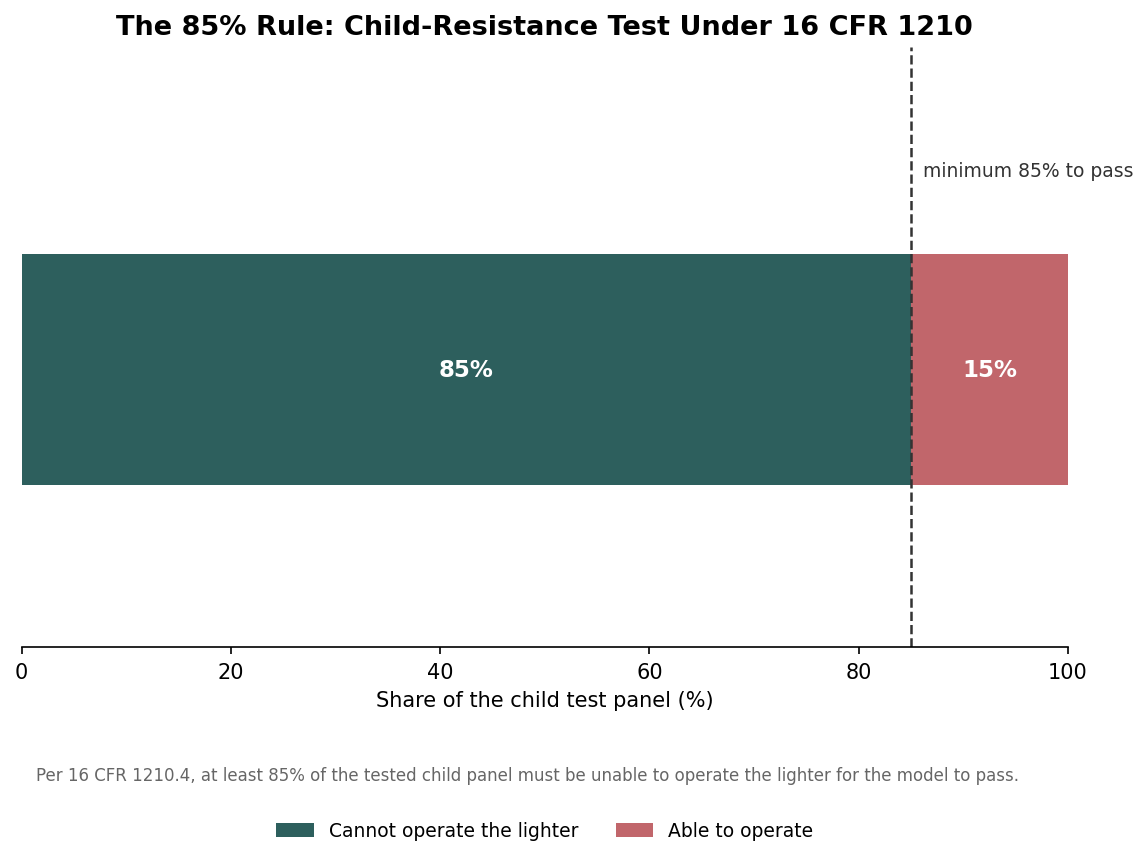
    A compliant lighter has to defeat at least 85 percent of a child test panel. Under the test protocol at 16 CFR 1210.4, the mechanism must prevent operation by a required share of the young children who try it, and the acceptance threshold is 85 percent. In plainer terms, out of a panel of children who attempt to work the lighter, no more than roughly fifteen in a hundred can succeed for the model to pass.

    Stacked bar showing at least 85 percent of a child test panel must be unable to operate a compliant lighter
    A compliant lighter must defeat at least 85% of the child test panel under 16 CFR 1210.4.

    This is why nearly every disposable lighter now has a stiff spark wheel, a guard, or a two-step ignition rather than a frictionless flick. The multi-purpose rule at Part 1212 applies the same 85 percent standard through its own test section, and hands-free utility models carry extra requirements, including a manual flame-off. When a supplier tells you a lighter is compliant, this test is the substance behind the claim.

    “Novelty” is a defined category, not a marketing word

    It is tempting to order a lighter shaped like your product, a cartoon, or a mascot. Before you do, understand that “novelty lighter” is a regulatory term, not a description. The CPSC defines it as a lighter that has entertaining audio or visual effects, or that depicts or resembles objects appealing to children under five, such as toys, cartoon characters, or animals. Federally these are not banned, but they are held to the same child-resistance requirement as any other disposable lighter, so the fun shape does not buy an exemption.

    State law is where a novelty shape can genuinely trip you up. A number of states go further than the federal rule and restrict or prohibit the sale and distribution of novelty lighters outright, and those laws vary in what they cover. If your concept leans toward a toy-like or character shape, confirm the rules in the states where the lighters will be handed out before you commit to the mold. A conventional slim or utility body sidesteps the question entirely.

    Certification: the paperwork behind a compliant lighter

    Compliance is not only a design matter; it is a documentation one. Manufacturers are required to submit a report to the CPSC at least 30 days before first distribution, including test data and prototypes demonstrating the model meets the standard. On top of that, Section 14(a) of the Consumer Product Safety Act requires a General Certificate of Conformity for lighters that fall under these rules.

    As a buyer, you are not the one filing this paperwork, but you benefit from confirming it exists. Asking a supplier whether the specific model you are ordering is a certified, compliant lighter, rather than accepting a general assurance that “our lighters meet the rules,” is a reasonable question and a quick way to tell a serious vendor from a careless one.

    Shipping: filled lighters are dangerous goods

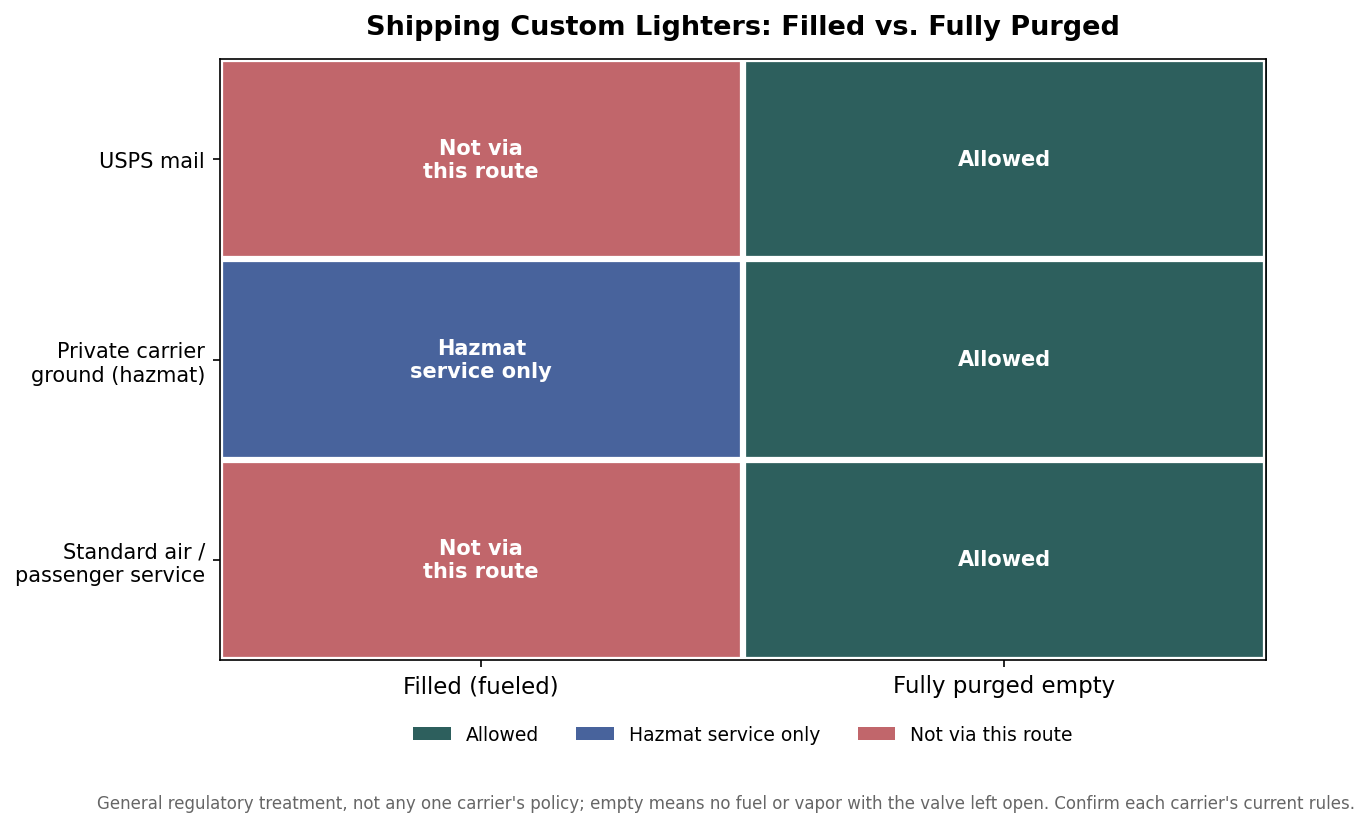
    Here is the part that most affects your timeline. A fueled lighter is a flammable-gas dangerous good, a Division 2.1 hazardous material, and it cannot simply drop into the regular mail. The United States Postal Service prohibits mailing filled lighters. Private carriers will move them, but only through dedicated ground hazardous-materials service with the training, packaging, and dangerous-goods documentation that classification demands. Standard air and passenger-service shipping is effectively off the table for a fueled lighter.

    Matrix of shipping channels showing filled lighters restricted to hazmat ground while purged empty lighters ship freely
    Filled lighters ship only via ground hazmat service; fully purged empties face far fewer limits.

    The matrix above shows the general regulatory treatment rather than any single carrier’s policy, and the details change with fuel state. An empty lighter, meaning one completely purged of fuel and vapor with the valve left open, faces far fewer restrictions and can even be mailed. In practice this rarely helps a promotional order, because you want the lighters to actually light, so plan on ground hazmat transit and its slower, less flexible timing. Build that into your lead time, order earlier than you would for a flat printed item, and confirm the delivery address is one a hazmat ground service will reach.

    None of these rules make custom lighters a bad promotional choice. They make it a considered one. Pick a compliant, certified model, keep clear of a novelty shape unless you have checked the states involved, and give the ground hazmat shipment the runway it needs, and the regulation becomes background noise rather than a problem on delivery week.

  • Wedding Favors Smokers Will Actually Keep: Branded Lighters Done Right

    Wedding Favors Smokers Will Actually Keep: Branded Lighters Done Right

    Most wedding favors get used once and forgotten. Custom-branded lighters are the rare exception — if any portion of your guest list smokes, vapes, or lights candles, your favor gets pocketed and used for weeks. Here’s how to do it right.

    Why Lighters Work as Favors

    They’re universally useful (birthday candles count). They’re small enough to set at every place setting. They get used long after the wedding. And smokers/vapers carry them — a walking reminder of your day.

    Design Ideas

    • Couple’s names + wedding date
    • Hashtag and venue
    • Custom monogram in your wedding colors
    • “Light up the night” or similar tagline

    Quantity and Placement

    Order 1.2x your guest count to allow extras. Place at the bar, the late-night snack station, or at each table setting if you want the design to feel intentional.

    A Note on Inclusivity

    Not every guest will use a lighter, but most know someone who does. Even non-smokers usually keep one in a kitchen drawer for candles. Don’t overthink the audience.

  • BIC vs Clipper vs Soft-Touch: Custom Lighter Body Types Compared

    BIC vs Clipper vs Soft-Touch: Custom Lighter Body Types Compared

    Three main custom lighter body types dominate the market: classic BIC, refillable Clipper, and soft-touch promotional bodies. Each has a feel, a price point, and an ideal use case. Here’s how to choose.

    BIC Style

    Best for: Mass giveaways, bar promotions, broad-distribution swag.

    Pros: Universal recognition. Reliable flame. Lowest per-unit cost. Disposable.

    Cons: Non-refillable. Smaller print area than soft-touch bodies.

    Clipper

    Best for: Music venues, smoke shops, dispensary swag, eco-conscious brands.

    Pros: Refillable (better sustainability message). Removable flint for relighting. Distinctive shape that fans collect.

    Cons: Higher unit cost. Some users prefer BIC feel.

    Soft-Touch Promotional Bodies

    Best for: Premium brand activations, gift sets, high-end venue merch.

    Pros: Premium tactile feel. Full-wrap printing with no seam. Photographs beautifully.

    Cons: Highest unit cost. Longer lead time.

  • Custom Lighters as Promo Swag: Why They Still Work in 2026

    Custom Lighters as Promo Swag: Why They Still Work in 2026

    Branded lighters have outlasted three decades of promo trends because they hit a rare combination: they’re cheap to produce, they get carried in pockets for weeks, and they get passed person to person. As a 2026 swag investment, they still deliver more eyeballs per dollar than just about anything else.

    Why Lighters Still Work

    • High retention. People don’t throw lighters away — they keep them or pass them on.
    • Carried, not stored. Goes in a pocket or purse, not a drawer.
    • Brand impressions per use. Every flick is a logo view.
    • Cheap per unit. Lower CPM than most other branded items.

    Who’s Using Branded Lighters in 2026

    Music venues, festivals, bars, dispensaries, smoke shops, music labels, brewery merch tables, tour merch — anywhere people gather and someone needs a light, branded lighters do the work.

    Design Considerations

    Full-wrap printing is the modern standard. Use the entire surface, not just the front panel. Bright colors photograph better on social.

  • The True Cost of Branded Lighters: A Margin Guide

    The True Cost of Branded Lighters: A Margin Guide

    Branded lighters work financially for retail counters — but only if you size the order right and price for impulse.

    Here’s the actual margin structure across the tiers we run, with a worked example for a typical 200-cover bar that does 800 transactions per week.

    Wholesale tier pricing

    Our per-unit pricing breaks roughly into five quantity bands. The economics of single-unit setup, plate engraving, and the labor portion of each lighter all compress as volume grows.

    • 100–249 units: $3.20/unit — good for an opening run or single-event test
    • 250–499 units: $2.40/unit — typical bar/restaurant first program
    • 500–999 units: $1.85/unit — multi-location or seasonal reorder tier
    • 1,000–4,999 units: $1.40/unit — small festival or franchise rollout
    • 5,000+ units: $0.95/unit — large tour merch or major brand promo

    Worked example: 200-cover bar

    Imagine you order 500 units at $1.85 = $925 wholesale. You price the lighter at $6 retail. Your margin per unit is $4.15. At a 4% conversion on your weekly 800 transactions, that’s 32 lighters/week, or $133/week in counter margin — about $575/month. The 500-unit order pays for itself in 7 weeks.

    The reorder lock-in

    Once you’re proven on the first run, the reorder economics improve sharply. We hold artwork and lock tier pricing for 12 months on the first order, so your second 500-unit run goes out in 2 weeks instead of 3 with zero new setup cost.

  • Engraving vs. Wrap Printing: Which Custom Lighter Finish Lasts?

    Engraving vs. Wrap Printing: Which Custom Lighter Finish Lasts?

    The finish on a custom lighter isn’t a cosmetic decision — it’s a durability, brand-reproduction, and unit-cost decision.

    We get the same question from venue owners weekly: should we go with laser engraving on a metal body, or a full-color wrap print? Here’s what actually changes between the two, and which use cases favor each.

    Laser engraving: durable but monochrome

    Laser engraving etches the logo directly into the metal body. It cannot fade, scratch off, or wear away — the artwork is the surface itself. The trade-off is that it’s monochrome (tonal contrast only, no real color), and intricate gradients or small typography below ~6pt don’t reproduce well.

    Best for: bar & restaurant programs (the design needs to survive dishwasher splashing and back-bar wear), hotel cigar lounge gifts, premium brand teams who want a tactile, high-end finish.

    Full-color wrap: vibrant but less durable

    Wrap printing applies a sublimation print or vinyl wrap around the lighter body, giving you full CMYK color reproduction with photographic detail. You can reproduce complex logos, gradients, and small typography. The wrap will start to show wear after 200–500 light cycles in heavy use environments.

    Best for: festival and concert tour merch (the lighter is the brand artifact, not the workhorse), wedding favors (one-time use), dispensary programs where vibrant brand color matters more than longevity.

    Unit cost difference

    At a 500-unit tier, laser engraving runs ~$1.85/unit and wrap printing runs ~$2.20/unit — a 19% premium for color. At 5,000+ units the gap narrows to under 10%. For most venue programs the engraving math wins; for tour merch and dispensary brand expression, the wrap is worth it.

  • How Branded Lighters Move at Bar & Restaurant Retail

    How Branded Lighters Move at Bar & Restaurant Retail

    Branded lighters at a bar counter or restaurant host stand do something most retail items can’t — they walk out of the venue with the customer and keep promoting the brand for weeks afterward.

    Across the venues we work with, a well-merchandised counter lighter program adds $200–600/month in pure-margin revenue at a typical neighborhood bar, and 2–4x that at high-volume cocktail spots, dispensaries, and hotel bars. This piece breaks down the playbook we’ve seen work, in order of operations.

    1. Choose one anchor design

    The first order should be a single design that matches your venue’s primary brand palette — not three colorways, not a seasonal variant. You’re testing whether the program works at all. A single SKU lets you read sell-through cleanly and gives staff one clear thing to upsell at point of sale.

    2. Price for repeat purchase

    A custom lighter at $5–8 retail with $1.40–2.40 unit cost is a 3–4x markup that customers actually buy as an impulse add-on. Anything above $10 starts to feel like a souvenir and the velocity collapses. Stay in the impulse zone.

    3. Merchandise at point-of-sale, not on a back wall

    Lighters move when they’re within reach of the register or POS tablet. The single biggest predictor of sell-through is physical placement within an arm’s length of where the customer pays. A small acrylic counter display or branded tin holds 30–50 units and replenishes weekly.

    4. Reorder cadence

    Bars that stock 50 units typically reorder every 6–10 weeks. Hotels with multiple bars and amenity placement reorder every 4–6 weeks. Build the reorder trigger into your inventory routine — when you’re down to 15 units, fire the reorder. We hold artwork on file and ship reorders in 2 weeks.