Author: Custom Lighters

  • Soft-Touch vs Metal Lighters: A Finish & Feel Guide for Promo

    Soft-Touch vs Metal Lighters: A Finish & Feel Guide for Promo

    Soft-Touch vs Metal Lighters: A Finish & Feel Guide for Promo

    Two lighters can carry the exact same logo and still send completely different signals depending on what’s in your hand. Soft-touch lighters have a matte, slightly rubberized coating that feels grippy and modern and keeps unit cost low, while a metal lighter feels substantial and premium the moment it’s picked up, at a meaningfully higher price. Neither finish is universally better — the right choice depends entirely on what the promo item is meant to say and where the budget sits.

    This guide compares soft-touch and metal lighter finishes on feel, print quality, durability, and cost, and helps you match the right one to your promo use case.

    How the two finishes actually differ

    Soft-touch lighters use a rubberized coating over a standard disposable body, giving a warm, grippy feel in hand and a surface that takes vivid full-color printing well. They’re inexpensive at volume, which is exactly why they dominate impulse-buy and mass-giveaway use cases where unit cost has to stay low across a large order.

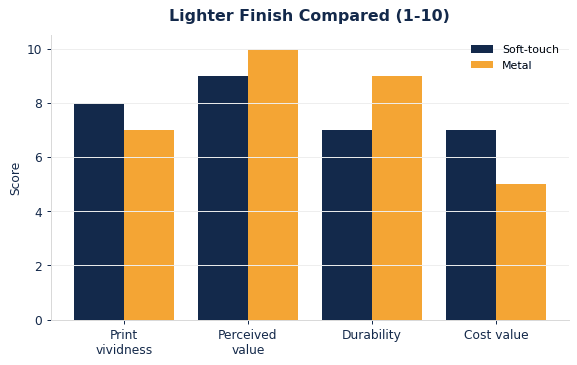
    Metal lighters, typically a refillable design with a hinged or flip top, feel heavier and more durable from the first touch, and that weight alone signals a higher perceived value before a logo is even considered. They cost noticeably more per unit and usually carry either an engraved mark or a printed design on a metal surface, which reads differently — more permanent, more collectible — than ink on rubberized plastic. The chart compares the two finishes on what promo buyers weigh most.
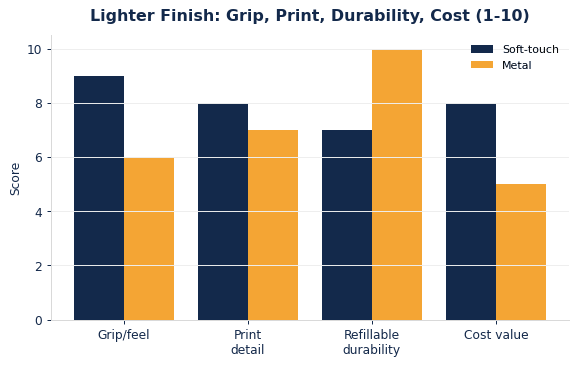
    Soft-touch and metal lighter finishes compared on grip, print, durability, and cost.
    Soft-touch and metal lighter finishes compared on grip, print, durability, and cost.

    Refillable vs disposable

    Most soft-touch lighters are disposable — used until empty, then tossed or replaced, which fits their role as a cheap, high-volume promo item. Metal lighters are usually refillable, which extends their working life well beyond a single fill and reinforces the premium positioning: a refillable lighter is a small object someone keeps and maintains, not a disposable giveaway.

    If your design has fine detail or a full-color gradient, soft-touch printing generally reproduces it more vividly than an engraved metal surface, which favors bold, simplified marks. Match your artwork complexity to the finish before finalizing a design. For where breweries specifically put lighters to work across a program, see our companion Custom Lighters for Breweries & Distilleries: Taproom Swag That Sells.

    Matching finish to your promo use case

    A festival giveaway, a bar or taproom register item, or a bulk event handout almost always calls for soft-touch — the volume is high, the budget per unit is low, and a lost or discarded lighter isn’t a real loss. A premium client gift, a retail shelf item positioned above the impulse-buy price point, or a collectible tied to a limited release fits metal far better, since the weight and refillable design justify a higher price and a slower, more intentional purchase decision.

    Retail shelf display is where the two finishes most often sit side by side, letting a shopper choose based on budget — a soft-touch option near the register and a metal option displayed as a step-up gift. The chart below shows how strongly each use case favors one finish over the other.
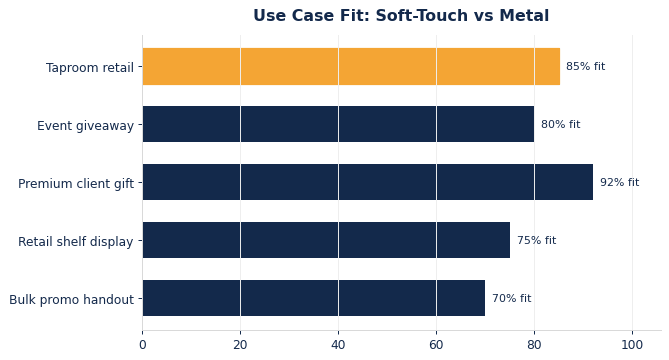
    How strongly different promo use cases favor soft-touch vs metal lighters.
    How strongly different promo use cases favor soft-touch vs metal lighters.

    Choosing a finish for your order

    The table below is a quick reference for matching finish to the most common promo scenarios.

    Use case Recommended finish Why
    Festival/event giveaway Soft-touch Low cost per unit at high volume
    Taproom register item Soft-touch Impulse-buy price point
    Premium client gift Metal, refillable Weight and permanence justify the price

    If budget allows, stocking both finishes lets you cover the impulse-buy shelf and the premium gift tier without forcing one compromise item to do both jobs. For where breweries and distilleries specifically deploy lighters across a full program, see our companion Custom Lighters for Breweries & Distilleries: Taproom Swag That Sells, and browse both finishes across our custom lighters range, or read about us for a deeper cost breakdown.

    Planning artwork and proofing around the finish you choose

    Artwork that looks great as a flat digital file doesn’t always translate cleanly to either finish, and the two require genuinely different design thinking rather than the same logo simply resized. Soft-touch printing handles gradients, fine text, and multi-color designs well, so a detailed logo or a photo-based design that would get lost on engraved metal can shine on a soft-touch surface. Metal engraving rewards the opposite approach — a bold, simplified mark with clean lines reads far better etched or engraved than a busy design ever will.

    Always request a physical proof before a full production run, regardless of which finish you choose, since screen mockups consistently misrepresent how ink sits on rubberized plastic versus how light catches an engraved metal surface. A proof reviewed under the actual lighting where the item will be sold or handed out — taproom lighting for a retail item, office lighting for a client gift — catches contrast and legibility issues that a studio photo of a mockup won’t reveal.

    Cost planning should account for more than the unit price difference between finishes. Metal lighters, being refillable and more durable, typically see a lower reorder frequency once distributed, since fewer get lost or discarded compared to disposable soft-touch versions. For a premium gift tier ordered less frequently but expected to last, that lower reorder rate is part of the value calculation, even though the upfront unit cost is higher than soft-touch.

    Sample both finishes before committing to one

    If budget allows, order a small sample batch of both finishes with the same logo before finalizing a large run. Seeing your specific artwork rendered both ways, side by side, makes the right choice for your use case far more obvious than judging from generic product photos.

    There’s also a sustainability angle worth considering alongside feel and price. A refillable metal lighter, used for years and refilled rather than discarded, generates far less waste per year of use than a disposable soft-touch lighter that gets tossed once empty. For a brand actively marketing sustainability, leaning toward metal as the primary promo item — or at minimum offering it as the upgrade option — reinforces that message in a way a disposable giveaway works against. It won’t replace the low-cost soft-touch option for high-volume giveaways, but it’s a detail worth mentioning when a client or partner specifically asks about the greener choice.

    Ordering a mixed batch of both finishes for the same campaign is more common than picking one exclusively, and it lets a single promo push cover more than one budget tier at once. A trade show booth, for instance, might hand soft-touch lighters to general foot traffic while reserving a small stock of metal lighters for qualified leads or existing accounts who stop by the booth, giving the team a natural way to signal who’s getting extra attention without saying so directly. Planning that split ahead of time, rather than deciding on the fly, keeps the higher-value item from running out before the people it’s meant for actually show up.

    Frequently asked questions

    Are soft-touch lighters as durable as metal?

    No — soft-touch lighters are typically disposable and built for a single fill’s use, while metal lighters are usually refillable and built to be kept and maintained over a much longer working life.

    Which finish prints logos more vividly?

    Soft-touch surfaces generally reproduce full-color and detailed artwork more vividly than engraved metal, which favors simpler, bolder marks. Match your design complexity to the finish before ordering.

    Choosing a lighter finish?

    Tell us your use case and budget and we’ll recommend soft-touch or metal, or get a quote.
    Get a Quote

  • Custom Lighters for Breweries & Distilleries: Taproom Swag That Sells

    Custom Lighters for Breweries & Distilleries: Taproom Swag That Sells

    Custom Lighters for Breweries & Distilleries: Taproom Swag That Sells

    Most brewery merch sits on a shelf until someone specifically decides to buy a t-shirt or a glass. Custom lighters for breweries move differently — they’re a small, low-commitment impulse buy at the register, cheap enough to grab without thinking twice, and useful enough that people actually reach for them again and again. For taprooms and distilleries looking for a retail item that turns over quickly, a branded lighter earns its shelf space in a way a lot of higher-priced merch doesn’t.

    This guide covers why custom lighters for breweries perform well at the register, the finish options that fit different price points, and where taprooms and distilleries put them to work beyond straight retail.

    Why lighters work as taproom retail merch

    Price point is the whole story: a lighter sits at an impulse-buy price near the register, low enough that a customer grabs one without deliberating the way they would over a twenty-dollar shirt. Because it gets used and often lost or given away, repeat purchases happen naturally — a customer who liked the design comes back for another one on their next visit, which is a purchase pattern most merch categories don’t get.

    A lighter also travels. It rides in a pocket, gets lent to a friend, sits on someone’s kitchen counter for months — all places where a brewery’s name and logo stay visible long after the visit. Compared to a coaster or a sticker, which tend to get tossed or forgotten, a functional item like a lighter keeps working as a small ongoing brand touchpoint. The chart compares soft-touch and metal finishes on what taproom buyers weigh most.

    Custom lighter finishes compared for print, value, durability, and cost.
    Custom lighter finishes compared for print, value, durability, and cost.

    Pricing a lighter for the register

    Most taprooms price a custom lighter low enough to be a genuine impulse grab — comparable to a pint upcharge, not a full merch purchase. That low price point is what drives the volume; keep the unit cost down with a soft-touch finish and simple one- or two-color print rather than an elaborate design that pushes retail price too high for the impulse-buy category to work.

    Refillable metal lighters cost more per unit but justify a higher retail price and work well as a step-up gift item near the register, separate from the cheaper impulse-buy soft-touch option. For a full finish and feel comparison between soft-touch and metal, see our companion Soft-Touch vs Metal Lighters: A Finish & Feel Guide for Promo.

    Where breweries and distilleries use them beyond retail

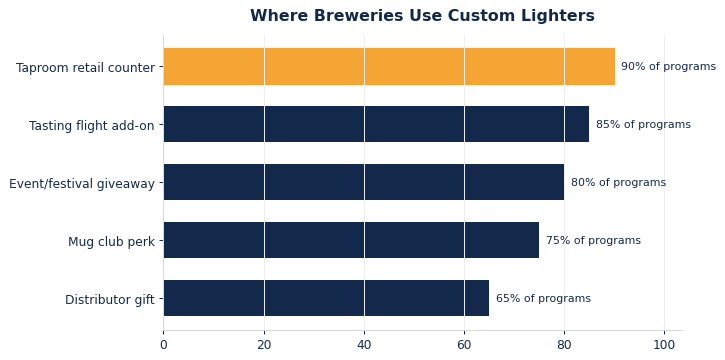
    The register is the obvious spot, but custom lighters for breweries show up across a program in other useful ways. A lighter tucked into a tasting flight or a mug club welcome kit adds a small tactile extra that costs little but reads as generous. Festival and event booths hand them out as a giveaway that’s more memorable and more likely to be kept than a flyer or a sticker.

    Distributor and account gifts are another quiet use case — a branded lighter dropped into a sales rep’s bag alongside a bottle is a small, low-cost touch that keeps the brand visible on someone else’s counter. The chart below shows how these use cases typically split across a brewery’s program.

    Where breweries and distilleries put custom lighters to work.
    Where breweries and distilleries put custom lighters to work.

    Planning a lighter order

    The table below is a quick way to match finish and design complexity to your primary use case.

    Use case Recommended finish Design
    Register impulse buy Soft-touch Simple 1-2 color logo
    Mug club/tasting kit add-on Soft-touch or metal Logo + member detail
    Distributor/account gift Metal, refillable Full-color or engraved

    Order in a batch large enough to hit a better per-unit price, since lighters scale like most small promo items — the unit cost drops meaningfully past a few hundred units. For the full finish and feel breakdown between soft-touch and metal, see our companion Soft-Touch vs Metal Lighters: A Finish & Feel Guide for Promo, and browse styles across our custom lighters range, or check about us for retail merchandising tips.

    Integrating lighters into a broader taproom merch strategy

    A lighter works best as part of a merch lineup rather than as an isolated item, since its low price point makes it a natural complement to higher-value pieces like apparel or glassware rather than a competitor for the same purchase decision. Placing lighters directly at the register, near where a customer is already committed to buying something else, captures the impulse-add sale far more reliably than a standalone display elsewhere in the taproom that requires a customer to make a separate trip.

    Seasonal and release-specific designs give lighters a reason to be collected rather than bought once and forgotten. A limited design tied to a specific beer release or a seasonal event turns a otherwise generic accessory into something regulars actively watch for, which drives the repeat-purchase pattern that makes lighters valuable as a retail category in the first place. Rotating designs a few times a year, rather than running one static design indefinitely, keeps the item feeling fresh at the register.

    Distributor and account-facing use deserves a slightly different design approach than retail. A lighter meant for a sales rep to hand to an account or drop into a gift bag should lean toward the brand’s core mark rather than a limited seasonal design, since it’s representing the brewery to someone outside the taproom who won’t have the context for an inside joke or a one-off release name. Keeping a standing, non-seasonal design in stock for exactly this purpose avoids running out of an appropriate option mid-sales-cycle.

    Bundle lighters into a starter merch pack

    For new taprooms or a fresh product launch, bundling a lighter with a coaster and a sticker into a low-cost starter merch pack gives new visitors an easy, affordable way to leave with something branded, building the same repeat-purchase habit from day one.

    Age verification and retail compliance are worth confirming with your supplier before stocking lighters at a register, since lighters are subject to specific regulations that other taproom merch isn’t. Confirming that your product meets relevant child-resistant and safety standards, and that your staff are aware of any age-verification requirement at checkout, protects the program from a compliance headache down the line. This is a quick conversation with a reputable supplier up front, but it’s not one worth skipping just because the item feels like simple, low-stakes merch.

    Tracking which design sells best is easier than most taprooms assume and worth doing from the first order onward. A simple note in the POS system tagging lighter sales by design, or even a rough tally at the register during a busy weekend, tells you within a month or two which colorway or artwork style is actually moving versus sitting in the display box. That data makes the next reorder decision far more confident than guessing, and it often reveals a surprising favorite design that’s worth expanding into other merch categories like coasters or stickers.

    Frequently asked questions

    What’s the best lighter finish for a taproom register?

    Soft-touch is the standard for a low-cost impulse buy at the register, since it keeps unit cost down while still printing bright, legible logos in one or two colors.

    Do custom lighters actually get repeat purchases?

    Yes — because lighters get lost, lent out, or run out of fuel, customers who liked the design often buy another on a later visit, which is a repeat-purchase pattern most brewery merch doesn’t see.

    Adding lighters to your lineup?

    Tell us your taproom or distillery volume and we’ll spec custom lighters, or get a quote.

    Get a Quote

  • Custom Lighters for Real Estate & Open-House Swag

    Custom Lighters for Real Estate & Open-House Swag

    Custom Lighters for Real Estate and Open-House Swag

    Real estate is a business of staying top-of-mind, and custom lighters are a small, useful giveaway that keeps an agent’s name in a prospect’s pocket long after the open house. Practical, inexpensive, and kept far longer than a flyer, branded custom lighters are an easy addition to an agent’s marketing kit. This guide covers using custom lighters as real estate and open-house swag.

    The goal of open-house swag is retention — something useful enough to keep, with your contact info on it. On that measure, a lighter outperforms most giveaways per dollar.

    Why lighters work as real estate swag

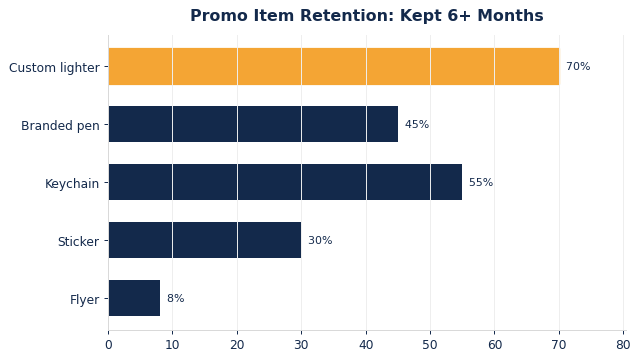
    Retention drives impressions, and a useful item stays around. Custom lighters are kept far longer than flyers or stickers, quietly carrying an agent’s name and number. The comparison below shows how promo items hold up.

    Custom lighters are kept longer than pens, keychains, stickers, and flyers.
    Custom lighters are kept longer than pens, keychains, stickers, and flyers.

    At an open house, a bowl of branded lighters by the sign-in sheet is a low-cost touch that visitors actually pick up and pocket.

    What to print on a real estate lighter

    Keep it clean: agent name, phone or QR code, and brokerage logo. A soft-touch body in brokerage colors reads premium, and a QR code linking to a listing or contact page turns the lighter into a lead tool, not just a novelty.

    Add a QR code to your listings page or contact card — it bridges a physical giveaway to a digital follow-up, and it costs nothing extra to print.

    Budgeting a real estate order

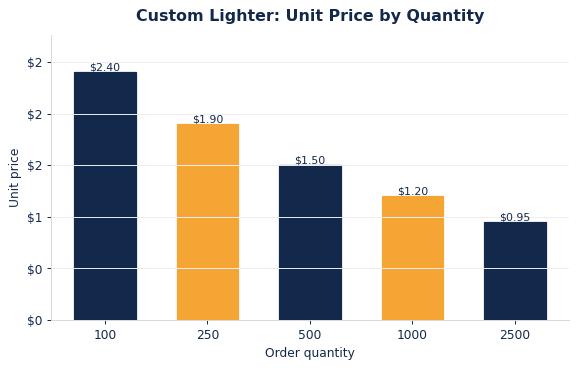
    Per-lighter cost is low and drops further with volume, so a year’s worth of open-house swag is inexpensive. The curve below helps you plan an order across listings and events.

    Per-lighter pricing falls sharply as order quantity increases.
    Per-lighter pricing falls sharply as order quantity increases.
    PrintPurposeNote
    Name + phoneContactCore info
    QR codeLead captureLinks to listings
    Brokerage logoBrandUse brand colors

    Deciding between arc and flame for the giveaway? See our companion guide, our Electric Arc vs Flame Lighters: Which to Brand for Promo. Explore our custom lighters, about us, or contact us.

    Why a lighter beats typical open-house giveaways

    Open-house swag succeeds when it is useful enough to keep, and a lighter clears that bar in a way most giveaways do not. A flyer is glanced at and tossed, a pen disappears, but a lighter lives in a pocket, a car, or a kitchen drawer for months, quietly carrying an agent’s name and number. That retention is the whole point of a giveaway, and it is why a small, practical item like a custom lighter delivers more impressions per dollar than flashier but forgettable alternatives.

    A lighter also fits the open-house setting naturally. A bowl of branded lighters by the sign-in sheet is a low-friction touch visitors actually pick up and pocket without a second thought, unlike bulkier swag they may decline to carry. Because it is genuinely useful and easy to take, the lighter travels home with the prospect, extending a brief open-house interaction into months of quiet exposure.

    Turning a giveaway into a lead tool

    The real upgrade is making the lighter do more than carry a name. Printing a QR code that links to the agent’s listings page or contact card bridges the physical giveaway to a digital follow-up, letting a prospect scan and reach out the moment they are ready. That turns a novelty into a lead-generation tool at no extra printing cost, which is exactly the kind of leverage a marketing item should provide.

    Keeping the printed information clean maximizes the effect. The agent’s name, phone number, and a QR code, plus the brokerage logo in the brand colors, is enough — a cluttered lighter reads as spam, while a clean one reads as professional. Designing the lighter with a clear purpose, a scannable link, and tasteful branding makes it a working piece of the agent’s marketing kit rather than just a handout.

    Design, body style, and brand fit

    A real estate lighter should reflect the agent’s brand, so the body and decoration matter. A soft-touch body in the brokerage colors reads premium and photographs well, while a wrapped full-color print maximizes logo and contact visibility. Choosing a body and decoration that match the agent’s positioning — understated and upscale, or bold and approachable — keeps the giveaway consistent with the rest of their marketing rather than feeling like generic swag.

    Consistency across an agent’s or brokerage’s materials strengthens recognition. When the lighter shares colors, logo, and tone with the agent’s signage, cards, and listings, every touchpoint reinforces the same brand. That coherence is what turns a pocketful of small giveaways into a recognizable presence, so speccing the lighter to match the agent’s look is worth the small effort.

    Budgeting a year of open-house swag

    Lighters are inexpensive per unit, and the cost drops further with volume, so a year’s worth of open-house swag is genuinely affordable. Ordering ahead for the season, rather than a small batch per event, secures the best per-unit price and ensures an agent always has branded lighters on hand for the next listing. A small overage covers busy weekends and multiple open houses without a rush reorder.

    Planning the order as a program keeps it simple. Standardizing on one body, one decoration, and a consistent contact-and-QR layout means reorders are a quick repeat, and keeping the artwork on file lets an agent restock in minutes. A little planning turns open-house swag into a reliable, low-cost part of an agent’s marketing that keeps their name in prospects’ pockets all year.

    Common questions about real estate lighters

    Why do custom lighters work as open-house swag?

    A lighter is useful enough to keep, so it lives in a pocket, car, or drawer for months carrying the agent’s name and number, unlike a flyer that is tossed. That retention delivers more impressions per dollar, and a bowl of lighters by the sign-in sheet is a low-friction touch visitors actually pocket.

    What should I print on a real estate lighter?

    Keep it clean: the agent’s name, phone number, and a QR code, plus the brokerage logo in the brand colors. A QR code linking to listings or a contact card turns the lighter into a lead tool at no extra printing cost, while a cluttered design reads as spam.

    How does a QR code help on a giveaway lighter?

    A QR code bridges the physical giveaway to a digital follow-up, letting a prospect scan and reach the agent’s listings or contact card the moment they are ready. It upgrades a novelty into a lead-generation tool without adding printing cost.

    What lighter style suits a real estate brand?

    A soft-touch body in the brokerage colors reads premium and photographs well, while a full-color wrap maximizes logo and contact visibility. Match the body and decoration to the agent’s positioning so the lighter is consistent with their other marketing.

    How many lighters should an agent order?

    Order ahead for the season rather than per event, since per-unit cost drops with volume and it ensures lighters are always on hand. A small overage covers busy weekends, and keeping the artwork on file makes restocking a quick repeat.

    Stocking open-house swag that gets kept?

    We’ll print branded lighters with your info and a QR code to your listings.

    Get a Quote
  • Electric Arc vs Flame Lighters: Which to Brand for Promo

    Electric Arc vs Flame Lighters: Which to Brand for Promo

    Electric Arc vs Flame Lighters: Which to Brand for Promo

    Custom lighters are one of the stickiest promo items there is, and the first choice is technology: an electric arc lighter or a classic flame. An electric arc lighter is rechargeable, windproof, and feels modern; a flame lighter is familiar, cheap, and universally understood. This guide compares the two so you brand the right lighter for your promo goals and audience.

    Both keep your logo in a pocket for months, but they suit different budgets and impressions. The right pick depends on price point and the message you want your swag to send.

    Electric arc vs flame

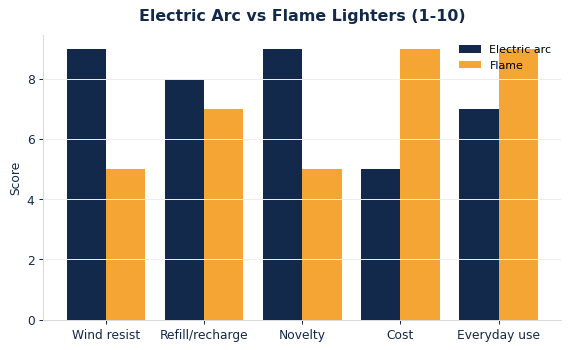
    An electric arc lighter wins on wind resistance, novelty, and rechargeability; a flame lighter wins on cost and everyday familiarity. The scores below compare the two for promotional use.

    Electric arc leads on windproof novelty; flame leads on cost and everyday use.
    Electric arc leads on windproof novelty; flame leads on cost and everyday use.

    For a premium, memorable giveaway, the electric arc lighter’s USB-rechargeable, flameless design turns heads; for high-volume, low-cost swag, a printed flame lighter is hard to beat.

    How brands use custom lighters

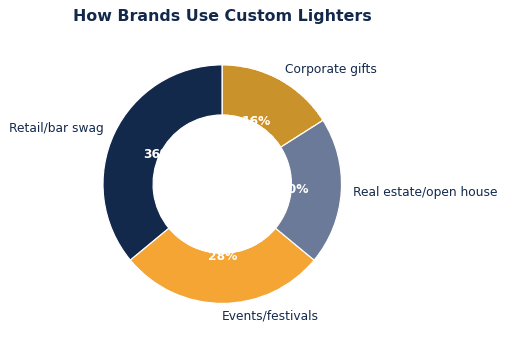
    Retail and bar swag lead, followed by events and festivals, real estate open houses, and corporate gifts. The breakdown below shows common uses of custom lighters.

    Retail, events, and real estate lead custom lighter promo use.
    Retail, events, and real estate lead custom lighter promo use.
    Handing lighters out where recharging is easy (a bar, an office)? The electric arc lighter’s premium feel pays off. For festival crowds and mass giveaways, flame lighters stretch the budget further.

    Branding and budget

    Both types take a wrap or engraved logo; soft-touch bodies photograph and feel premium. Electric arc units cost more per piece but justify it as a nicer gift, while flame lighters shine on cost at scale.

    TypeBest forNote
    Electric arcPremium giftsUSB rechargeable
    FlameMass swagLowest cost
    Soft-touchEitherPremium feel

    Planning a specific campaign like open houses? See our companion guide, our Custom Lighters for Real Estate & Open-House Swag. Explore our custom lighters, about us, or contact us.

    How each lighter technology actually works

    Understanding how the two technologies work explains their strengths as promo items. An electric arc lighter uses a rechargeable battery to create a small, high-temperature plasma arc between two electrodes, producing a flameless ignition that is unaffected by wind and needs no fuel refills, just a USB charge. A traditional flame lighter burns butane through a wick or jet, delivering the familiar open flame everyone knows how to use, refuelable or disposable depending on the model. Each mechanism shapes how the lighter performs and how it is perceived.

    These mechanisms drive the promo trade-offs directly. The arc lighter’s windproof, rechargeable, flameless design feels modern and premium, which turns heads as a giveaway, but it costs more per unit and needs charging. The flame lighter’s simplicity and low cost make it unbeatable for high-volume swag where familiarity and price matter most. Knowing the underlying technology helps you pick the one whose strengths match your campaign.

    Matching the lighter to your audience and setting

    The right choice often comes down to where and to whom you are handing lighters. For a premium gift, a bar or lounge, an office, or anywhere recharging is easy, the electric arc lighter’s upscale feel pays off and the USB recharge is a non-issue. For festival crowds, mass giveaways, and settings where lighters are used and passed around casually, a printed flame lighter stretches the budget and matches expectations. Picturing the recipient and the moment guides the decision.

    Brand positioning plays in too. A tech-forward or premium brand may prefer the arc lighter’s modern story, while a value or high-volume promotion leans flame for reach. Because both keep your logo in a pocket for months, the question is less about which is better and more about which fits the audience, the setting, and the impression you want the giveaway to make.

    Branding, body styles, and decoration

    Both technologies offer strong branding real estate, and the body style shapes the look. Arc lighters often come in sleek metal or soft-touch bodies that photograph well and take a wrapped or engraved logo, reinforcing a premium feel. Flame lighters range from classic metal cases to economical plastic bodies, with printing that wraps the barrel for maximum logo visibility at low cost. Choosing the body and decoration together ensures the finished lighter looks the part for its tier.

    Decoration method affects durability and perception. A wrapped full-color print maximizes logo impact on a flame lighter, while laser engraving on a metal arc lighter feels understated and premium. Soft-touch coatings add a tactile, upscale feel to either. Matching the decoration to the body and the campaign’s tier keeps the branding consistent with the impression you want the lighter to leave in a recipient’s pocket.

    Budgeting and ordering a promo run

    Cost scales with technology and volume, so budgeting starts with the tier. Electric arc lighters carry a higher unit cost but justify it as a nicer gift for a smaller, targeted list, while flame lighters shine on cost at scale for broad giveaways. Per-unit pricing drops with quantity for both, so ordering for your full campaign at once is the efficient path, with a small overage for staff and extra demand.

    Lead time and consistency round out the order. Confirm production and shipping against your event or campaign date, allowing a little longer for wrapped full-color or engraved runs, and standardize on one body and decoration so reorders stay simple. Planning the run this way delivers a lighter that fits the audience and the budget while keeping your branding consistent across a season of promotions.

    Common questions about promotional lighters

    Electric arc or flame lighter for promo?

    Choose an electric arc lighter for a premium, memorable giveaway where recharging is easy, and a flame lighter for high-volume, low-cost swag where familiarity and price matter most. Both keep your logo in a pocket for months, so match the tech to your audience and setting.

    Are electric arc lighters worth the higher cost?

    For a premium or targeted giveaway, yes — the windproof, rechargeable, flameless design feels modern and upscale, which turns heads. For mass giveaways where cost and familiarity matter more, a flame lighter is the better value.

    How are custom lighters branded?

    Both types take a wrapped or engraved logo. Flame lighters often use a full-color wrap around the barrel for maximum visibility at low cost, while metal arc lighters suit understated laser engraving. Soft-touch bodies add a premium tactile feel to either.

    Where do brands use custom lighters?

    Retail and bar swag lead, followed by events and festivals, real estate open houses, and corporate gifts. Hand arc lighters out where recharging is easy for a premium feel, and use flame lighters for festival crowds and mass giveaways to stretch the budget.

    How many lighters should I order?

    Order for your full campaign at once, since per-unit pricing drops with volume, plus a small overage for staff and extra demand. Confirm lead time against your date, allowing a little longer for wrapped full-color or engraved runs, and standardize on one body and decoration so future reorders stay simple and consistent.

    Choosing lighters for your promo?

    We’ll match arc or flame, body style, and branding to your audience and budget.

    Get a Quote
  • Custom Lighters as Band & Festival Merch

    Custom Lighters as Band & Festival Merch

    Custom Lighters as Band & Festival Merch

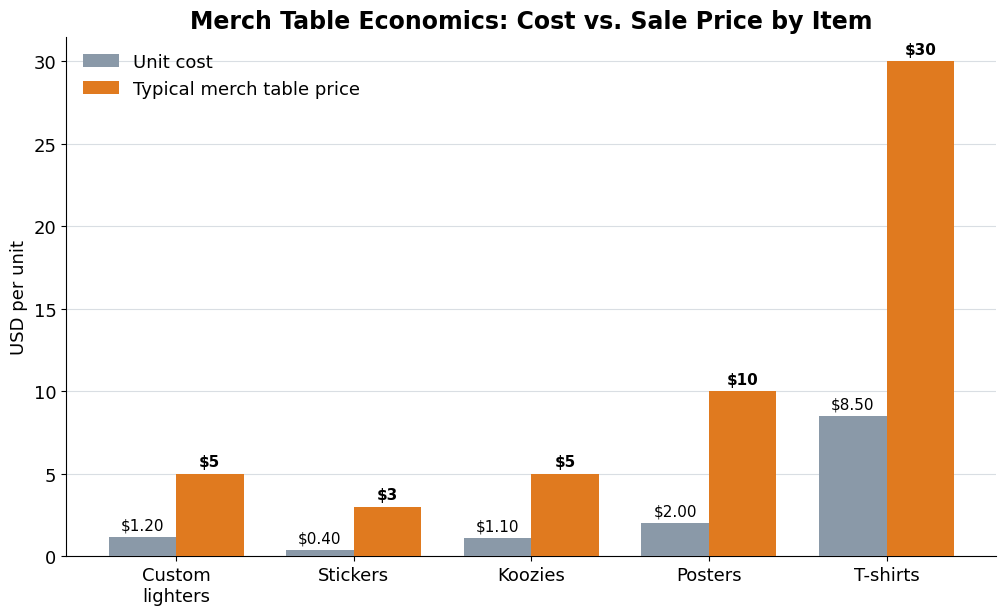
    Every band knows the merch table math: t-shirts carry the table, but the small stuff pays the gas money. Custom lighters for bands have quietly become one of the best-performing small items in live music — a $1.20 unit that sells for $5, doubles as a show accessory the moment the encore starts, and keeps your band’s name in a fan’s pocket for months. This guide breaks down the economics, design approaches, ordering timelines, and how festivals and venues use branded lighters beyond the merch table.

    Why Lighters Work at the Merch Table

    Great small merch has three properties: low unit cost, an impulse-friendly price point, and actual usefulness. Lighters hit all three harder than almost anything else on the table.

    Grouped bar chart comparing unit cost and merch table price for five items, showing custom lighters costing 1.20 dollars and selling for 5, versus t-shirts costing 8.50 and selling for 30
    Lighters return over 4x their cost at a $5 price point — with none of the size-inventory headaches of apparel.

    Run the numbers against the rest of the table. A shirt costs $8.50 and sells for $30 — great dollars, but you’re carrying four sizes times every design, and dead sizes eat your margin. A lighter has no sizes, no colorways to guess, weighs nothing in the van, and sells to the fan who already spent their shirt money. At $5 each or two for $8, they’re the “add-on” purchase that bumps average spend at every transaction.

    There’s also the part no spreadsheet captures: a lighter is the only merch item fans literally hold up during the show. That’s your band name glowing in a crowd of raised hands — user-generated marketing you sold to them at a 4x markup.

    The Economics: What Bands Actually Clear

    Typical wholesale pricing for one-color printed soft-flame lighters runs roughly $1.40 at 100 units, $1.20 at 250, and under a dollar at 1,000. Here’s what that looks like across a modest tour:

    OrderUnit CostSell PriceSell-ThroughProfit
    250 lighters$1.20$5.0080% (200 sold)$700
    500 lighters$1.05$5.0075% (375 sold)$1,350
    1,000 lighters$0.90$5.0070% (700 sold)$2,600

    Even the leftover stock isn’t waste — unsold lighters become giveaway items for street teams, radio drops, and green-room gifting. Unlike a crate of size-small tees from the last album cycle, a lighter never goes out of style with your logo on it.

    Design Approaches That Sell

    Fans buy lighters that look like the band, not like an ad. Three approaches consistently outperform:

    • Album-art wraps. Full-color UV printing turns the lighter body into a miniature of the current record. Collectible, especially as a numbered tour edition.
    • Logo-plus-tour-dates. The classic. Band mark on one side, tour name and year on the reverse. Fans keep dated items — they’re proof of attendance.
    • Lyric or inside-joke editions. A single line fans recognize instantly. These sell on identity, and they’re the ones that get posted online.

    Body color matters more than bands expect: matte black with a single bright ink color reads best under merch-table lighting, and white bodies show artwork most accurately if you’re running full-color prints. For metal and hard rock acts, torch-style jet flame units in gunmetal sell at a premium $8–$10 price point.

    Pro tip: Price lighters as an add-on, not a standalone. Train whoever runs your table to offer “add a lighter for $3” with every shirt purchase. Attach rates of 30–40% are common, and the discounted add-on still clears more than double its cost.

    Festival and Venue Plays

    Festival merch programs use custom lighters differently than touring bands. Festivals order 5,000–20,000 units as sponsored items — often with a sponsor logo on the reverse side offsetting the entire cost — and sell or gift them at info booths and camping check-in. For multi-day camping festivals, a lighter is genuinely useful gear, which makes it one of the few branded items attendees seek out rather than tolerate.

    Venues and promoters run a third model: house lighters sold at the bar alongside concert lighters for touring acts, with a split-branding layout (venue on one side, “presented by” on the other). If you operate a venue with a smoke patio, a $5 house lighter at the bar register is the same impulse-margin play a cigar shop runs — and our companion guide to custom torch lighters for cigar lounges and smoke shops covers that retail counter strategy in depth.

    Timeline: Ordering Around a Tour

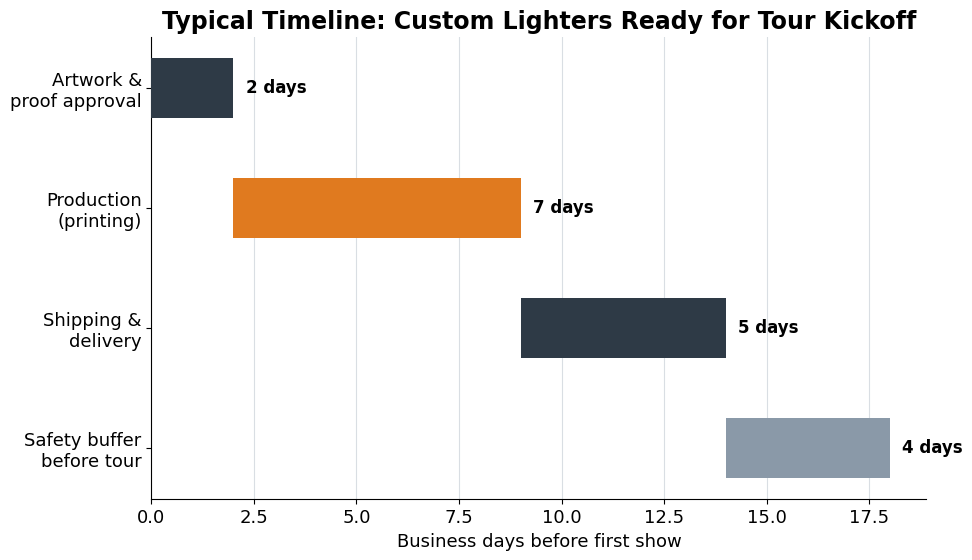
    Timeline chart showing 18 business days from artwork approval to tour kickoff: two days proofing, seven days production, five days shipping, four days buffer
    Plan about 18 business days from artwork approval to have lighters in hand before the first show.

    Custom lighters for bands are a fast turnaround item by merch standards, but butane products ship ground-only, so pad the schedule. Two days for proof approval, about a week in production, five days shipping, and a safety buffer puts you at roughly three and a half weeks out. Practical rule: place the order when the tour poster is finalized, since the same artwork approval usually covers both.

    Ship to your first venue or your merch manager, not a home address you’ll leave before the truck arrives — a lesson bands tend to learn exactly once.

    Getting Started

    For a first run, 250 units with a one-color logo print is the low-risk entry: about $300 all-in, profitable after 60 sales. Scale to full-color album art editions once you know your sell-through. However you slice it, custom lighters for bands deliver the best margin-to-hassle ratio on the small-merch side of the table — no sizes, no dead stock, and free advertising every time one leaves a pocket.

    Want to see printing methods, body styles, and minimums across our range? Start at the homepage, browse more guides on the blog, or read about our shop.

    Ready to light up the merch table?

    Get bulk pricing on custom lighters for your band, festival, or venue — free digital proof with every quote.

    Get a Quote
  • Custom Torch Lighters for Cigar Lounges & Smoke Shops

    Custom Torch Lighters for Cigar Lounges & Smoke Shops

    Custom Torch Lighters for Cigar Lounges & Smoke Shops

    A soft flame lighter struggles the moment you step onto a patio, but a jet flame laughs at the wind — which is exactly why custom torch lighters have become the signature branded item for cigar lounges, smoke shops, and premium tobacco retailers. They’re functional enough that customers actually keep them, premium enough to carry a logo with pride, and cheap enough at bulk pricing to hand out or sell at a healthy margin. This guide covers flame configurations, pricing at wholesale quantities, printing options, and how lounges and shops turn torch lighters into a genuine revenue line.

    Why Torch Lighters Beat Standard Lighters for Tobacco Businesses

    Regular soft-flame lighters are fine for cigarettes, but they’re the wrong tool for cigars. A cigar needs an even, wind-resistant flame hot enough to toast the foot without tarring the wrapper with lighter fluid flavor. Jet flame lighters burn butane at roughly 2,400°F in a focused blue cone, which lights a 54-ring-gauge cigar evenly in seconds — indoors or on a breezy patio.

    For your brand, that functional difference matters. A free plastic lighter gets pocketed and forgotten. A torch lighter with a firm click, a visible fuel window, and your logo on the body gets used at every herf, golf outing, and back-deck smoke — and shown to other cigar people, who are exactly your customers.

    Single, Dual, or Triple Flame: Choosing a Configuration

    Single jet

    The economy workhorse. Lights cigarettes, pipes, and smaller ring gauges; sips fuel. Best for high-volume giveaways where unit cost rules.

    Dual jet

    The versatile middle ground — enough spread for most cigars, still compact. A popular pick for shop-counter retail.

    Triple jet

    The lounge standard. Three converging jets toast a large ring gauge quickly and evenly. Heavier bodies, cigar punches on the base, and fuel windows are common at this tier. If your clientele smoke 60-gauge sticks, this is the one they’ll actually use.

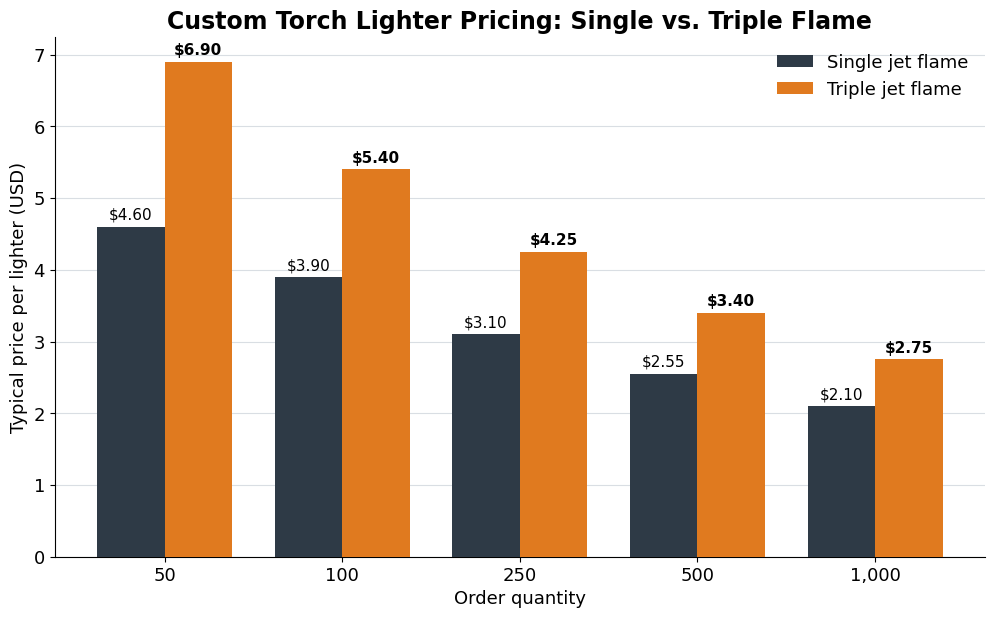
    Grouped bar chart of custom torch lighter pricing showing single flame falling from 4.60 to 2.10 dollars and triple flame from 6.90 to 2.75 dollars as quantity rises from 50 to 1000 units
    Quantity drives cost down fast: triple-jet units drop from $6.90 each at 50 pieces to $2.75 at 1,000.

    What Custom Torch Lighters Cost in Bulk

    Ordering torch lighters bulk is where the economics get interesting. Setup and imprint costs amortize across the run, and body costs fall at container-quantity breaks. The table below shows typical all-in pricing for a logo-printed unit, including one-color imprint:

    QuantitySingle JetTriple JetTypical Buyer
    50$4.60$6.90Single lounge, event test run
    100$3.90$5.40Lounge counter retail
    250$3.10$4.25Smoke shop, multi-event season
    500$2.55$3.40Shop chains, festival vendors
    1,000$2.10$2.75Distributors, franchise groups

    At those numbers, retail margin is straightforward: a triple-jet lighter that costs $4.25 at the 250 tier sells all day at $12.99–$19.99 on a counter display. Even at the low end, that’s roughly 3x cost — better margin than most tobacco accessories on your shelf.

    Who’s Ordering — and What They Do With Them

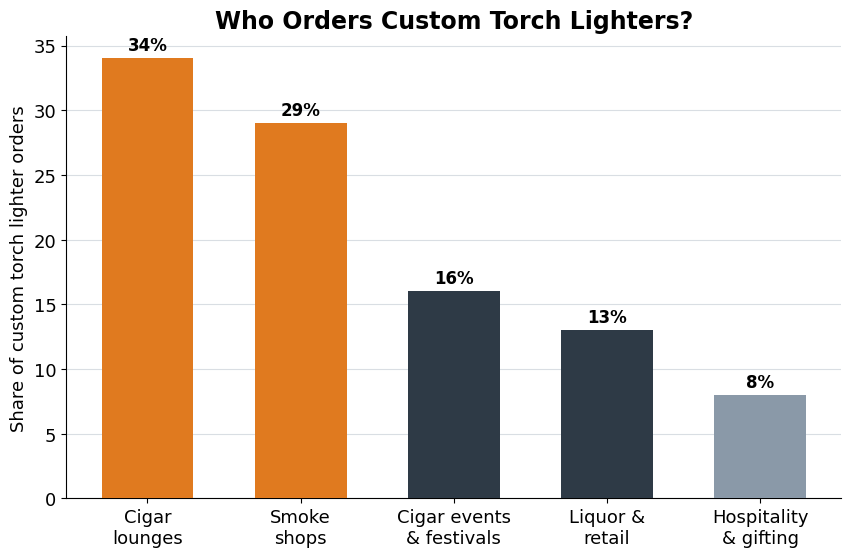
    Bar chart showing share of custom torch lighter orders by buyer type: cigar lounges 34 percent, smoke shops 29 percent, cigar events 16 percent, liquor and retail 13 percent, hospitality 8 percent
    Cigar lounges and smoke shops account for nearly two-thirds of custom torch lighter orders.

    The use cases cluster into three plays:

    • Counter retail. A branded acrylic display of 20 lighters by the register. Impulse purchase, strong margin, and every sale walks your logo out the door as cigar lounge merch that keeps working for you.
    • Membership and VIP gifting. Lounges include a triple-jet lighter in new-member welcome kits or locker renewals. Perceived value far exceeds the bulk cost.
    • Event presence. Cigar festivals, brand nights, and golf tournaments. A torch lighter is the item attendees still own two years later — long after the koozies and lanyards are gone.
    Pro tip: Order refillable units with a visible fuel window for retail and gifting, and reserve cheaper sealed units for mass giveaways. A refillable lighter stays in service for years — and your logo stays in rotation with it. The extra 60–80 cents per unit buys years of additional impressions.

    Printing and Branding Options

    Torch lighter bodies take branding several ways, and the right method depends on your artwork:

    • Pad printing — the standard for one- or two-color logos; crisp and economical at any quantity.
    • UV full-color printing — photographic detail and gradients, ideal for label-style artwork or event editions.
    • Laser engraving — on metal-body units, engraving gives a premium, permanent mark that won’t wear off with pocket carry. The best choice for VIP and top-shelf retail pieces.

    Design guidance: keep the imprint area simple. Most bodies give you roughly 1″ x 1.5″ of usable space, so a clean logo plus one line of text (shop name or city) reads best. Metallic body colors — gunmetal, brushed silver, matte black — consistently outsell bright plastics in lounge settings.

    Compliance and Shipping Notes

    Two practical points buyers should know. First, butane lighters ship as regulated goods, so expect ground-only shipping and a few extra transit days — plan three to four weeks from artwork approval to delivery. Second, if you sell lighters at retail in certain states, child-resistance and labeling rules can apply; reputable suppliers ship compliant units by default, but ask if you’re unsure. Neither issue is a real obstacle — it just rewards ordering ahead of your event calendar rather than two weeks before a festival.

    Getting Started

    If you’re a lounge or shop testing the waters, start at the 100–250 tier with a triple-jet, refillable unit and a one-color imprint. That’s enough inventory to stock a counter display, seed your regulars, and see sell-through before committing to distributor quantities. Custom torch lighters at that tier typically land under $5 a unit — a small bet for an item with this kind of retention.

    Bands, venues, and event brands use the same playbook with a different audience — see our companion guide to custom lighters as band and festival merch for that angle. And for more on body styles, MOQs, and printing methods across our whole range, browse the blog, learn about our shop, or start from the homepage.

    Ready to put your logo on a jet flame?

    Get bulk pricing on custom torch lighters for your lounge, shop, or event — free digital proof with every quote.

    Get a Quote
  • Refillable vs Disposable Custom Lighters: Which for Your Brand

    Refillable vs Disposable Custom Lighters: Which for Your Brand

    Refillable Custom Lighters vs Disposable: Which Fits Your Brand

    Every brand that hands out lighters eventually asks the same question: buy refillable custom lighters that guests keep for years, or disposable printed ones that move through more hands at a lower per-unit cost? There is no universally correct answer, but there is a clear way to think about it once you separate upfront spend from cost per year and from how many times your logo actually gets seen.

    This guide compares refillable and disposable lighters across the factors that matter for a promotional order: cost, perceived value, the effort of keeping refill fluid in stock, and total brand impressions over the life of the item. If you run a bar or restaurant and want the placement and pricing side of the decision, our companion guide on custom lighters for bars covers ordering by quantity and where venues typically put branded lighters to work.

    The core trade-off

    Disposable lighters win on unit price and on how many you can hand out for a fixed budget. A single order of a few thousand disposable printed lighters can blanket an event, a bar, or a trade show floor at a cost per piece that a refillable metal lighter cannot match. Refillable custom lighters flip that math over a longer time horizon: a guest who keeps a metal lighter in a jacket pocket for a year or two carries your logo through far more pockets, bars, and conversations than a disposable one that runs dry in a few weeks and gets thrown away.

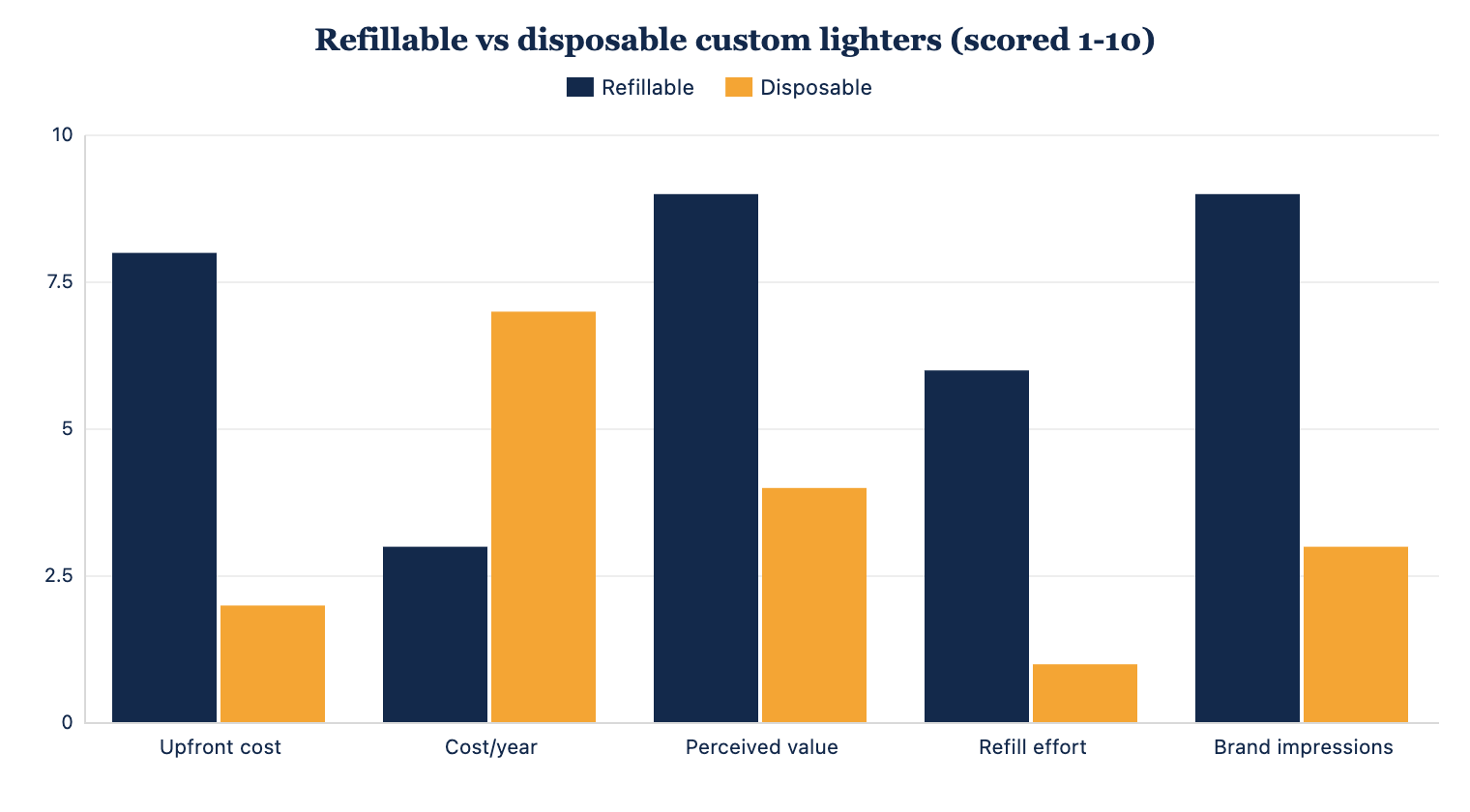
    Refillable versus disposable custom lighters compared across five factors, scored 1 to 10
    Refillable versus disposable custom lighters compared across five factors, scored 1 to 10.

    The chart above scores both types across the factors that actually drive a purchasing decision. Disposable lighters score low on upfront cost, meaning they are cheap to buy in bulk, but score high on cost per year because a venue or event keeps reordering them every few months. Refillable lighters flip that pattern: a higher sticker price per unit, but a lower ongoing cost once you account for how long a single lighter stays in circulation and how many refills it takes before it wears out.

    Perceived value and how guests treat each type

    People treat a metal refillable lighter differently than a plastic disposable one, and that difference shows up in behavior, not just materials. A disposable lighter gets grabbed from a bowl, used a handful of times, and left behind at the next bar without much thought. A well-made refillable lighter, especially one with a weighted metal body and a laser-etched logo, tends to get pocketed, kept on a keychain, or handed down rather than discarded, which is exactly the kind of long-term brand exposure most promotional budgets are trying to buy.

    That perceived-value gap matters most when the lighter is meant to represent the brand rather than just serve a functional need. A construction supply company handing out branded lighters at a trade show booth, or a distillery giving one away with a bottle purchase, usually gets more mileage from a refillable option that feels like a small gift rather than a giveaway.

    Refill effort is the real cost of ownership

    The catch with refillable lighters is that someone has to actually refill them, and butane fluid is not something every guest keeps on hand. Brands that lean into refillable stock either include a small bottle of fluid with a premium gift set or accept that a portion of recipients will simply retire the lighter once it runs dry rather than refill it. Disposable lighters have close to zero refill effort by design: when the fuel runs out, the lighter is thrown away and the guest reaches for a new one, which is part of why disposable stock still dominates high-volume giveaways.

    Counting brand impressions per dollar

    The most useful way to compare the two types head to head is cost per thousand impressions, treating every time a lighter is seen, used, or handed to someone else as one impression. Because a refillable metal lighter stays in circulation for months or years instead of weeks, its impression count per unit is usually far higher than a disposable one, even though the upfront price is higher too.

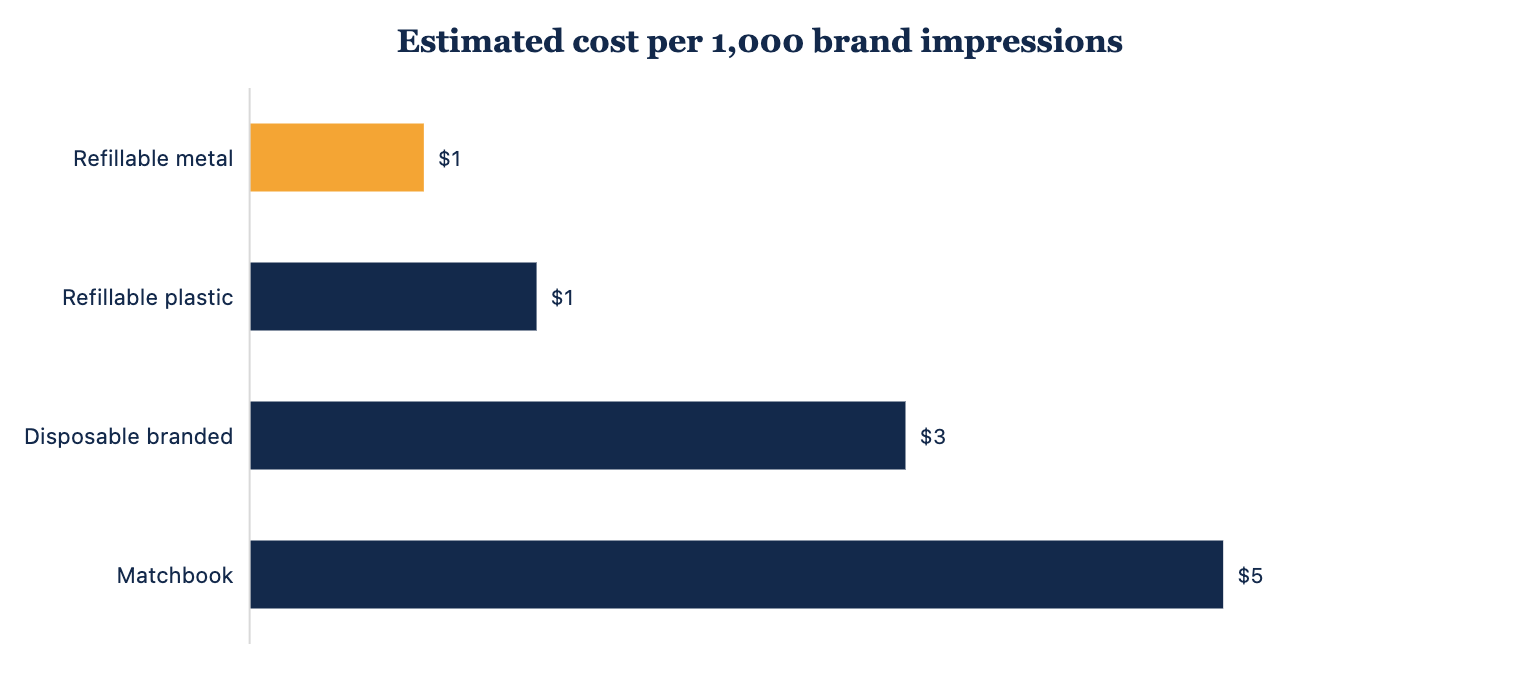
    Estimated cost per 1,000 brand impressions by lighter type
    Estimated cost per 1,000 brand impressions by lighter type.

    Refillable metal lighters typically come out ahead on this measure, followed by refillable plastic-bodied lighters, with disposable branded lighters and printed matchbooks trailing behind. A matchbook is the cheapest single item to produce, but it gets used up in a handful of strikes and thrown away, so its cost per thousand impressions is often the highest of the group despite the low sticker price.

    Lighter typeBest forTypical lifespan
    Refillable metalVIP gifts, retail, long-term brand recall1-3 years
    Refillable plasticMid-tier giveaways, repeat customers6-18 months
    Disposable brandedBars, events, high-volume handouts2-6 weeks
    MatchbookRestaurants, low-cost table itemSingle use
    Running a bar or restaurant and mostly deciding on volume and placement rather than lighter type? Our companion guide, custom lighters for bars, breaks down pricing by order quantity and where venues typically put branded lighters into circulation.

    How to decide for your brand

    Start with how the lighter fits into your broader promotional mix. If you are handing out hundreds or thousands of items at a bar, festival, or trade show and expect most of them to be lost or discarded within weeks, disposable stock is the more efficient use of budget. If you are building a smaller batch of higher-value items for retail sale, VIP gifting, loyalty rewards, or a limited product launch, a refillable lighter’s higher perceived value and longer lifespan usually justify the higher unit cost.

    Mixing both types

    Many brands do not have to choose only one. A common approach is disposable stock for high-volume handouts at the register or bar, paired with a small run of refillable metal lighters reserved for top customers, staff, or press kits. That combination captures the reach of disposable giveaways while still having a premium item on hand when the audience or occasion calls for something better than a bowl giveaway.

    Budgeting across both formats

    A workable starting split for a mid-size brand is roughly 80 percent of the promotional budget on disposable stock for reach and 20 percent on a smaller refillable run for retention. Track which format actually drives repeat mentions or social shares over a season, then adjust the split for the next order rather than guessing at ratios twice a year.

    Bottom line

    Disposable lighters win on reach and upfront budget; refillable lighters win on perceived value and cost per impression over time. Match the type to the occasion, budget for refill fluid if you go refillable, and consider stocking both if your brand touches a wide range of audiences. Whichever direction you choose, ordering refillable lighters or disposable stock in the right print method keeps your logo legible for the full life of the item.

    Get pricing on refillable or disposable lighters

    Tell us your budget and audience and we will recommend the right lighter type and print method for your brand.

    Get a Quote

    Home · About · Buying guides · Companion guide: custom lighters for bars

  • Custom Branded Lighters for Bars & Restaurants

    Custom Branded Lighters for Bars & Restaurants

    Custom Lighters for Bars: A Buying Guide for Restaurants & Nightlife

    If you run a bar, restaurant, or nightlife venue, custom lighters for bars are one of the cheapest, highest-frequency ways to put your logo in a guest’s hand and keep it there for weeks. A printed lighter costs pennies at volume, gets used dozens of times before it runs out or gets lost, and rides around in a pocket or purse long after the receipt is thrown away. Few promotional items match that combination of low cost and long dwell time.

    This guide covers how to buy custom lighters for bars and restaurants: how venues actually use branded lighters, what drives the price at different order sizes, and how to think about refillable versus disposable stock before you place a first order. If you are weighing refillable metal lighters against disposable printed ones, our companion piece on refillable versus disposable custom lighters walks through that decision in more depth.

    Why bars keep reordering branded lighters

    Ashtrays are mostly gone, but lighters are not. Smoking sections moved outdoors, patios turned into semi-permanent hangout spots, and a lighter is still the one item almost every smoking guest needs and rarely brings enough of. A bar that keeps a bowl of printed lighters near the register or hands one out with a first round solves a real, recurring problem for the guest while quietly advertising the venue every time it gets pulled out at another bar, a friend’s house, or a concert.

    The economics work in the venue’s favor too. Because unit costs drop sharply at higher quantities, a bar ordering a few thousand lighters a year often pays less per unit than it does for napkins or coasters, while getting a promotional item that leaves the building with the guest instead of getting thrown out with the table settings.

    Where venues put custom lighters to work

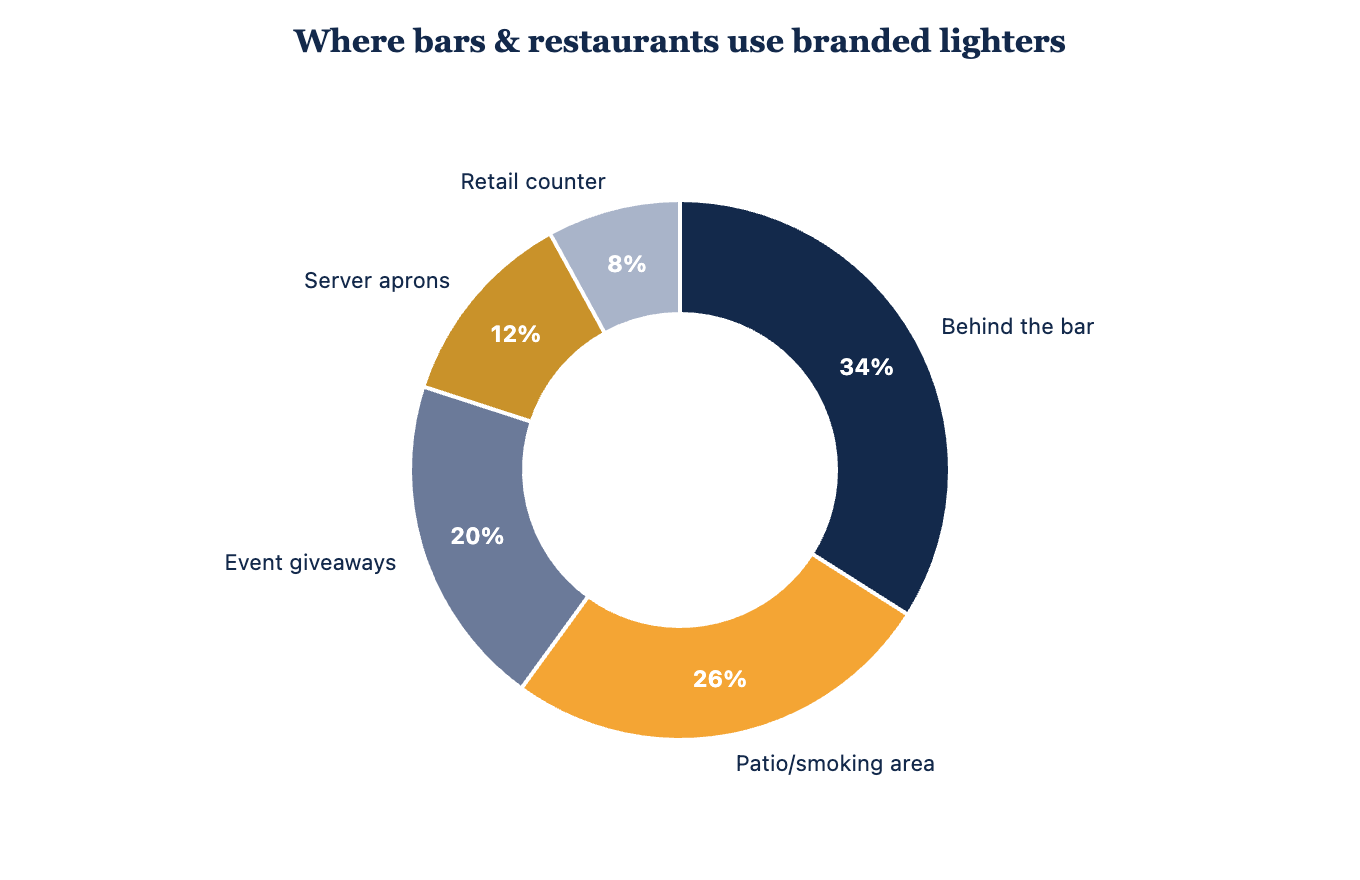
    Placement matters almost as much as the print itself. The chart below breaks down where bars and restaurants typically put branded lighters into circulation, based on common ordering and distribution patterns reported by venue buyers.

    Where bars and restaurants put custom branded lighters into circulation
    Where bars and restaurants put custom branded lighters into circulation.

    Behind-the-bar stock is the largest use case: bartenders hand one over with a round or a pack of cigarettes bought at the register, and it doubles as a small thank-you for a good tip. Patio and smoking-area bowls are a close second, since that is where guests actually need a flame and where a logo gets seen by everyone standing nearby. Event giveaways, server aprons stocked for quick handouts, and a small retail counter display round out the rest, giving a venue several low-friction ways to move inventory without making it feel like a hard sell.

    What drives the price

    Custom lighter pricing follows a familiar promotional-product curve: a high per-unit cost at small quantities that flattens out fast as the order grows. Setup charges for the print plate or laser template get spread across more units, and suppliers typically pass along volume discounts on the blank lighters themselves once an order crosses a few thousand pieces.

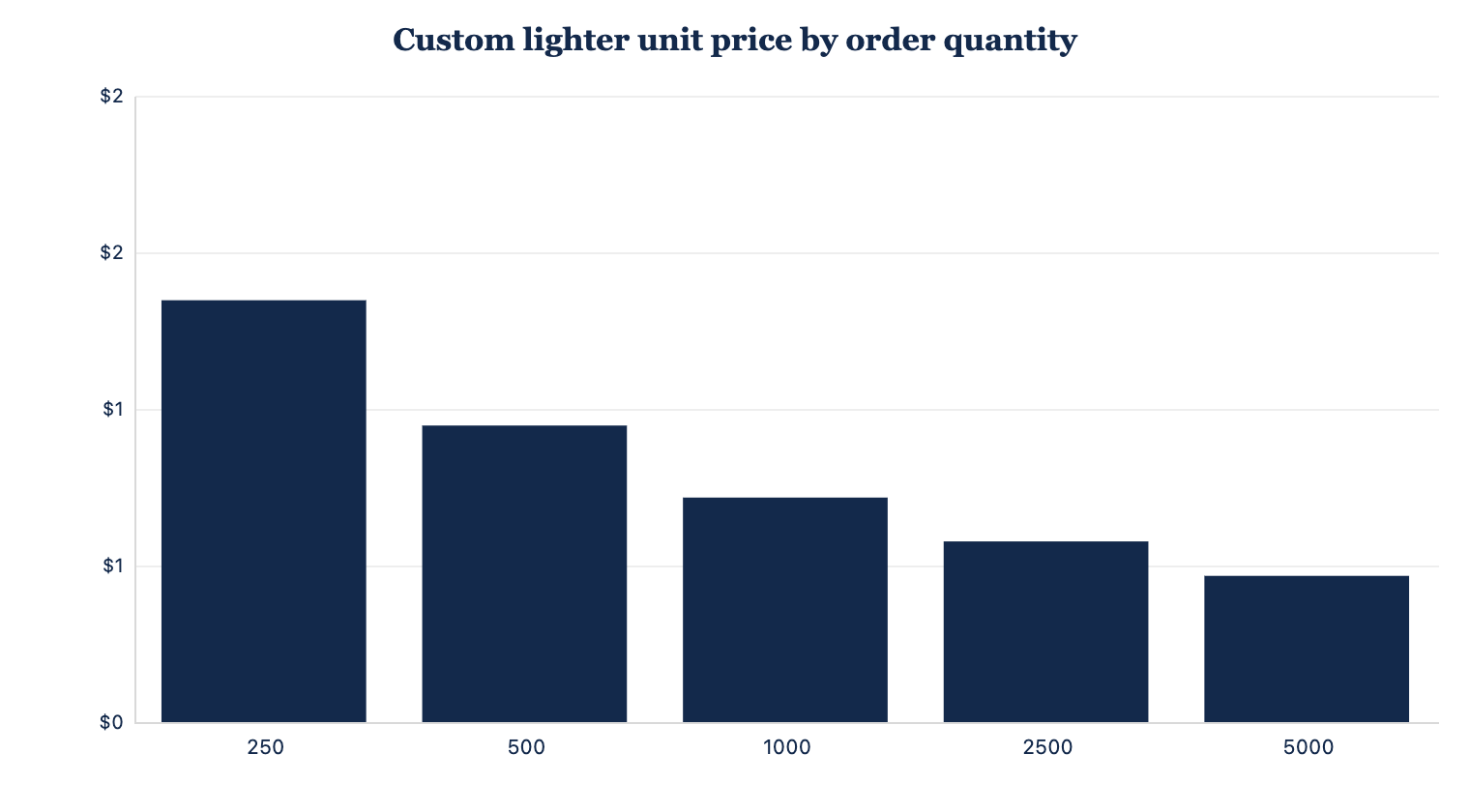
    Typical unit price for custom printed lighters by order quantity
    Typical unit price for custom printed lighters by order quantity.

    For a single-location bar, an order in the 500 to 1,000 range is usually the sweet spot: large enough to get past the steepest part of the price curve, small enough to sell through before a menu or logo update makes the stock feel dated. Multi-location groups and distributors ordering 2,500 or more see meaningfully lower unit costs, which is why regional bar groups often centralize lighter orders rather than letting each location buy small batches separately.

    Print method and how it affects cost

    Most bars choose between a one- or two-color screen print, a full-wrap label, or a laser-etched finish on a metal lighter. Screen printing is the budget default for disposable stock, a full wrap gives the most vivid multi-color logo on a plastic lighter, and laser etching is reserved for refillable metal lighters that a venue treats more like a keepsake than a giveaway. Each step up in print quality adds a modest amount to unit cost but also extends how long the branding stays legible through pocket wear.

    PlacementTypical lighter typeWhy it works
    Behind the barDisposable, single-color printLow cost, handed out frequently
    Patio / smoking areaDisposable, full-wrap labelHigh visibility, replenished often
    Event giveawaysDisposable or refillable, bold logoMemorable takeaway from a themed night
    Retail counterRefillable metalHigher perceived value, sold rather than given
    Trying to decide between a refillable metal lighter and a disposable printed one for your venue? Our companion guide, refillable vs disposable custom lighters, compares upfront cost, cost per year, and brand impressions side by side.

    Ordering tips specific to bars and restaurants

    Because a venue’s logo or tagline can change with a rebrand or a new drink menu, most bars are better off ordering disposable stock in the 500 to 1,500 range every few months rather than locking in one huge batch of 10,000 that outlives the current branding. That keeps the design current and avoids a back room full of outdated inventory.

    Seasonal and event-specific runs are worth a small separate order rather than folding into the standing house stock. A short run printed for a holiday party, a sports-viewing promotion, or an anniversary night gives guests a reason to grab one immediately instead of assuming the bowl will always be there, and it lets a venue test a design before committing to a larger reorder of the everyday house version.

    Compliance and age considerations

    Because lighters are an ignition source, most reputable suppliers require venues to confirm the giveaway is going to guests of legal smoking age and will decline orders intended for distribution to minors. Keeping lighters behind the bar or at a staffed counter rather than in an open, unsupervised area also keeps a venue on the right side of most local ordinances while still getting the branding benefit.

    Working with a design that scales

    Because the print area on a lighter is small, a logo that reads well at business-card size usually needs simplifying before it goes on a lighter panel. Stick to one or two colors, drop fine detail, and lean on a wordmark or simplified icon rather than a full multi-element logo. A design that gets approved for a small run of 250 should scale cleanly to 5,000 without a redo, which saves a round of proofing when you reorder later in the year.

    Bottom line

    For bars and restaurants, custom lighters remain one of the few promotional items that guests actually want, actually keep, and actually use in front of other people. Order a size that matches how often your branding changes, pick a print method that matches the price tier, and put stock where guests are most likely to reach for it. Get those details right and a bowl of custom lighters for bars pays for itself many times over in walking-around advertising.

    Get a custom lighter quote for your venue

    Tell us your logo, colors, and typical order size and we will put together bar-ready pricing across quantities.

    Get a Quote

    Home · About · Buying guides · Companion guide: refillable vs disposable custom lighters

  • Custom Lighter Printing Methods Compared: Engrave vs Wrap vs Photo

    Custom Lighter Printing Methods Compared: Engrave vs Wrap vs Photo

    The way your logo is applied to a lighter decides how it looks on day one and whether it still looks good months later in a pocket or purse. Choosing a custom lighter printing method is the most important decision in any branded-lighter order, because each method trades durability for color and detail differently. This guide compares the main custom lighter printing methods so you can match the right one to your artwork, your budget, and how the lighters will be used.

    The Four Main Methods

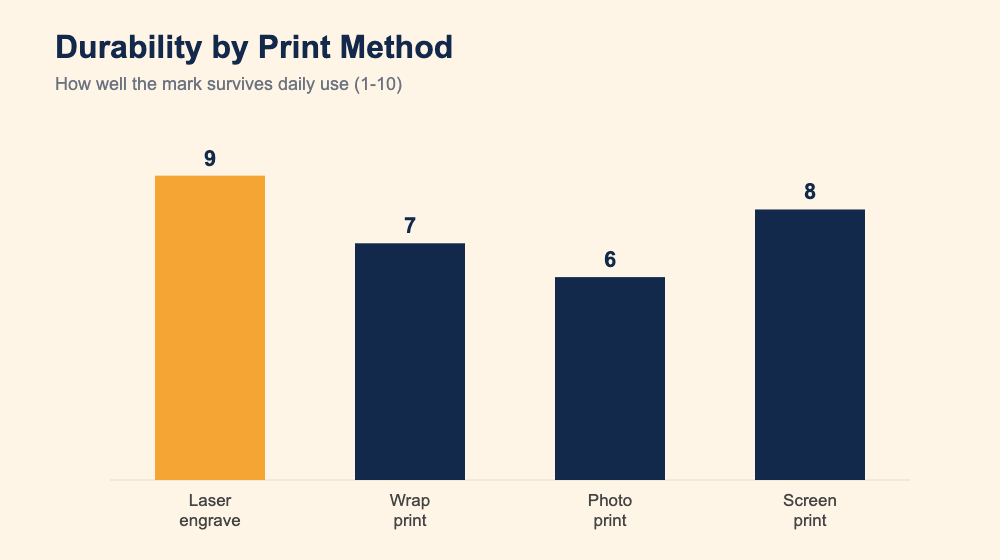
    Most branded lighters are decorated one of four ways: laser engraving, full-wrap printing, photo printing, or screen printing. The first question is always durability — how well the mark survives real-world handling.

    Bar chart of durability by method: laser engrave 9, screen print 8, wrap print 7, photo print 6

    Laser engraving wins on durability because the design is physically etched into the surface and cannot rub off. Printed methods sit on top of the lighter, so their longevity depends on the finish and coating.

    Color and Detail

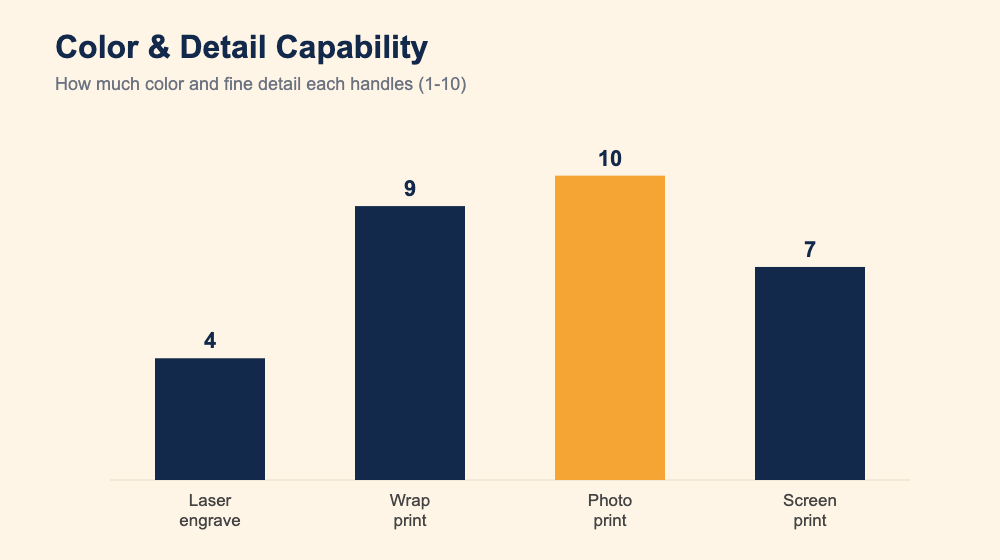
    Durability is only half the story. If your logo has gradients, photos, or many colors, engraving cannot reproduce them — it is single-tone by nature.

    Bar chart of color and detail capability: photo print 10, wrap print 9, screen print 7, laser engrave 4
    MethodBest forWatch out for
    Laser engraveLogos, premium feel, longevitySingle tone only
    Wrap printFull-color, edge-to-edge designsNeeds a quality clear coat
    Photo printPhotographic art, gradientsLower scratch resistance
    Screen printBold, simple logos in bulkLimited fine detail

    Matching Method to Use Case

    For corporate swag and bar promotions that need to look premium and last, laser engraving is hard to beat. For festival merch, wedding favors, or anything with a colorful design, wrap or photo printing brings the artwork to life. High-volume giveaways with a simple one-color logo are where screen printing is most economical.

    Not sure which fits your artwork? See how we work, browse the blog, or send us your logo for a recommendation.

    Choose Your Method and Order

    The right custom lighter printing method comes down to two questions: how colorful is your art, and how long should it last? Engrave for durability and a premium feel, print for full color. Tell us your design and quantity and we will recommend the method and send a quote with free mockups.

    Get a Quote